
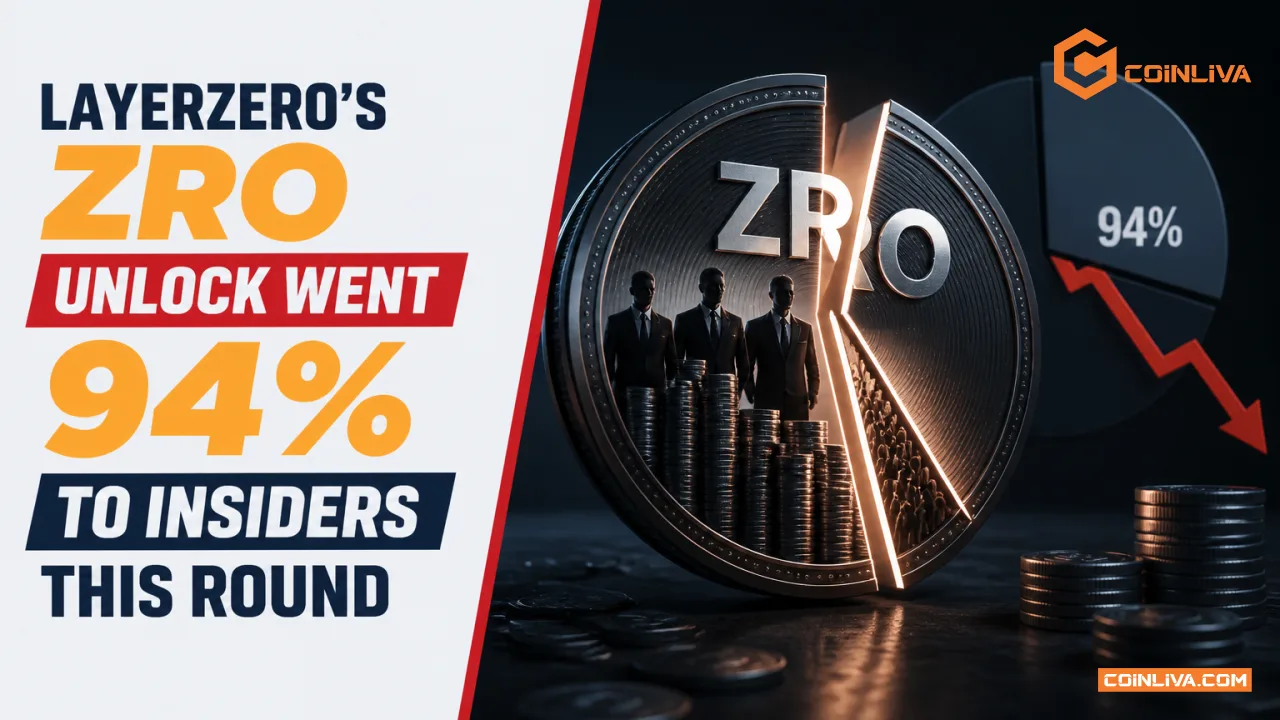
LayerZero released 25.71 million ZRO on August 20, and almost none of it reached the people who actually use the network. The August 20 ZRO unlock split three ways: strategic partners, core contributors, and a smaller batch the team had bought back.
Add the first two and you get 24.05 million tokens. That is about 94% of the release. It was worth close to $20 million at the prices around the unlock, and nearer $25 million now that ZRO changes hands at $1.00.
Where the 25.71 million went
The split is not subtle. Strategic partners took 13.42 million ZRO. Core contributors took 10.63 million. The remaining 1.67 million were tokens LayerZero had repurchased.
Not a single token in this ZRO unlock went to a fresh community distribution, an airdrop, or a rewards program. That matters because the locked part of the supply is what is still vesting, so this release reads as a clean signal of who owns the tokens that have not moved yet.
| Group | Share of 1B total supply |
|---|---|
| Community | 38.3% |
| Strategic partners | 32.2% |
| Core contributors | 25.5% |
| Repurchased by team | 4.0% |
Read that as an allocation rather than a headline. Strategic partners and core contributors together hold 57.7% of the full billion-token supply, against 38.3% for the community line. Most of the community share is already out and trading, while most of the insider share is still on a vesting clock.
The valuation gap says the same thing. At $1.00, the market prices ZRO near $360 million, yet the fully diluted value sits at $1 billion. That difference, roughly 640 million tokens, is supply the market has not paid for yet, and the August split shows who is holding most of it.
The float trackers cannot agree on
Here the math turns slippery. One digest called the August 20 ZRO unlock 4.4% of supply. Another put it at 7.3%. Same 25.71 million tokens, two answers, because the trackers do not share a float.
Tokenomist and DefiLlama both show circulating supply near 353 million ZRO. CoinMarketCap lists 369 million. The 4.4% reading only holds against a 584 million count that neither of the first two uses. When the denominator swings by more than 200 million tokens, the percentage everyone quotes stops carrying much weight. That gap between a project's paperwork and the trackers is not unique to ZRO. It showed up plainly in the Prove unlock, where the docs said 100 million and trackers logged 233 million.
Why the community's share keeps sliding
DefiLlama's breakdown makes the drift explicit. Insiders sit at 52.4% of circulating supply today and climb toward 65.4% once the vesting finishes. The farming and community bucket runs the other way, from 39.6% down to 28.8%. So holders keep their tokens and lose their proportion, one insider unlock at a time.
The next ZRO unlock lands around September 19, another roughly $23 million split between strategic partners and core contributors, the same two buckets that took this one. LayerZero has spent August defending the technical side, most visibly when Nethermind moved its verification work off LayerZero toward Chainlink. The token side tells a plainer story, closer to Story's stop-start insider unlock than to any community rollout. Buyers who came for the community pitch are watching a cap table quietly catch up with them.