
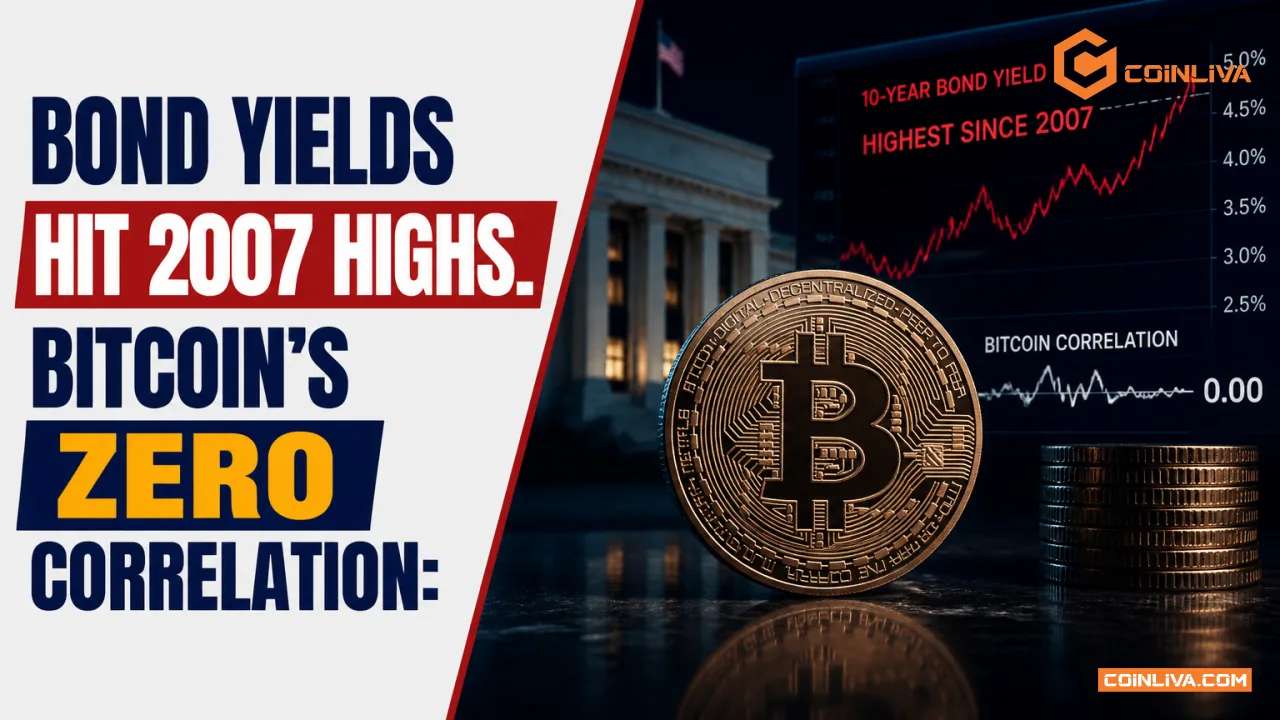
Bitcoin dropped 3% to $83,200 on September 24 as the 10-year Treasury yield jumped 15 basis points to 5.13%, its highest level since 2007. Every headline blamed the move on rising yields. The data says otherwise.
Bitcoin's one-year correlation with U.S. Treasury yields sits at -0.03, according to CoinDesk analysis of daily returns. The 90-day correlation measured -0.18, and the 180-day reading came in at -0.06. All three figures round to zero. Bitcoin has risen 191% since 2021 while global yields climbed 400 to 500 basis points across developed markets.
The yield-sensitive narrative breaks down under scrutiny. Bond yields increased because the S&P Global Composite PMI hit 58.4 in September, the fastest business expansion in five years. Stronger growth pushes yields higher through increased credit demand, not fiscal deterioration. Yet fiscally vulnerable economies saw disproportionate yield increases: France and the U.K. both experienced jumps exceeding 500 basis points since 2021, while Switzerland's yields rose just 105 basis points over the same period.
The Volatility Mechanism Nobody Mentioned
The MOVE Index, which measures Treasury market volatility, surged 21% to 95 points on September 24. That reading marked the highest level since April 1. The index tracks expected bond price swings over the next month, and sharp moves signal broader financial stress regardless of yield direction.
Lacie Zhang, Research Lead at Bitget Wallet, pointed to bitcoin's near-zero correlation with bond yields as a genuine portfolio advantage. The asset operates independently from duration-based trading dynamics that govern traditional bond-equity allocation. When Treasury volatility spikes, however, the mechanism changes. Volatility itself, distinct from bond yields, can trigger risk-off positioning that pressures all non-yielding assets simultaneously.
Bitcoin fell from $87,200 to $83,500 on the day bond yields hit 5.13%. Ethereum dropped 1.55%, XRP slid 2.87%, and Solana declined 1.61%. The S&P 500 futures fell 0.61% while Nasdaq 100 futures dropped over 1%. Gold, another non-yielding asset, declined 0.71%. The pattern suggests contagion from bond market stress rather than a yield-specific mechanism.
What the Five-Year Window Reveals
The disconnect between bitcoin's price action and rising bond yields becomes clearer over longer timeframes. Bitcoin reached a record $126,000 in October 2025, up from lows near $16,000 in late 2022. That rally unfolded as central banks raised rates aggressively and yields climbed from pandemic-era lows.
Robin Brooks, Senior Fellow at the Brookings Institution and former chief economist at the Institute of International Finance, noted that Treasury yield increases were driven by economic strength rather than fiscal concerns. The distinction matters because growth-driven yield increases typically correlate with stronger risk appetite, while fiscal-driven spikes signal deteriorating sovereign credit and broader instability.
U.S. debt-to-GDP reached 123.8% by the end of 2025, according to Statista. Japan's ratio exceeded 200%, France hit 115%, and the U.K. sat at 102%. Despite these elevated levels, bitcoin's correlation with yields remained negligible. The asset's performance showed no consistent relationship with debt sustainability metrics across major economies.
The Cost-of-Capital Argument Falls Apart
The conventional narrative holds that rising bond yields increase the opportunity cost of holding non-yielding assets like bitcoin. If risk-free government bonds offer 5% returns, the theory goes, speculative assets must deliver higher expected returns to justify the allocation. Empirical data contradicts this framework across multiple timeframes.
Bitcoin ETFs recorded inflows of $347 million on September 24 despite the yield spike and price decline, according to data cited by Cointelegraph. Institutional investors continued accumulating positions through spot ETFs even as yields hit multi-decade highs. The behavior suggests portfolio managers view bitcoin as uncorrelated to traditional fixed-income allocations rather than a direct substitute.
Fidelity Digital Assets research has consistently shown bitcoin's low correlation with major asset classes as a primary driver of institutional adoption. The asset's statistical independence from bonds, equities, and commodities makes it valuable for portfolio diversification regardless of absolute yield levels. A 5% Treasury yield does not change bitcoin's correlation properties.
Short-Term Pressure vs. Long-Term Independence
The distinction between bond yields and volatility explains why bitcoin can fall on days when bond yields surge while maintaining near-zero correlation over longer periods. Short-term volatility in any major market can trigger systematic position unwinding and risk reduction across all speculative positions. Crypto markets, which operate 24/7 with high position concentration, often react first to these flows.
CME FedWatch data showed traders pricing in a 75.3% probability of an October rate hike to the 4.00-4.25% range following the September 24 economic data. That represented an increase from roughly 55% probability earlier in the month. The rapid repricing of Fed expectations drove the Treasury volatility spike more than the absolute yield level.
Asian and European traders bought the dip after U.S. markets drove bitcoin below $84,000, suggesting regional investors viewed the decline as a temporary overreaction rather than a fundamental reassessment of bitcoin's value proposition. The asset recovered to $84,100 within hours as historical patterns reasserted themselves.
Why Bond Yields Don't Drive Bitcoin
Bitcoin does not care about rising bond yields over the long term. The asset has posted triple-digit percentage gains while yields climbed from near-zero to multi-decade highs. What bitcoin does care about is sudden volatility in major markets, regardless of the direction or the specific asset class experiencing stress.
The MOVE Index tells the real story. When Treasury volatility remains contained, bitcoin trades independently from yield movements. When volatility surges, risk assets broadly face selling pressure as margined positions unwind and systematic strategies reduce exposure. The yield level itself carries little predictive power for bitcoin's medium-term trajectory.
Institutional participation in crypto markets has grown substantially since regulatory clarity improved throughout 2026. Bitcoin's statistical properties as an uncorrelated asset remain the primary attraction for sophisticated allocators. A 5.13% yield on the 10-year Treasury does not eliminate that correlation benefit, which is why flows into bitcoin ETFs continued even as headlines warned of yield-driven pressure.
The next time bitcoin falls on a day when yields rise, check the MOVE Index before assuming causation. The data over one year, 90 days, and 180 days all point to the same conclusion: the yield-bitcoin correlation that markets obsess over in real-time simply does not exist when measured rigorously.