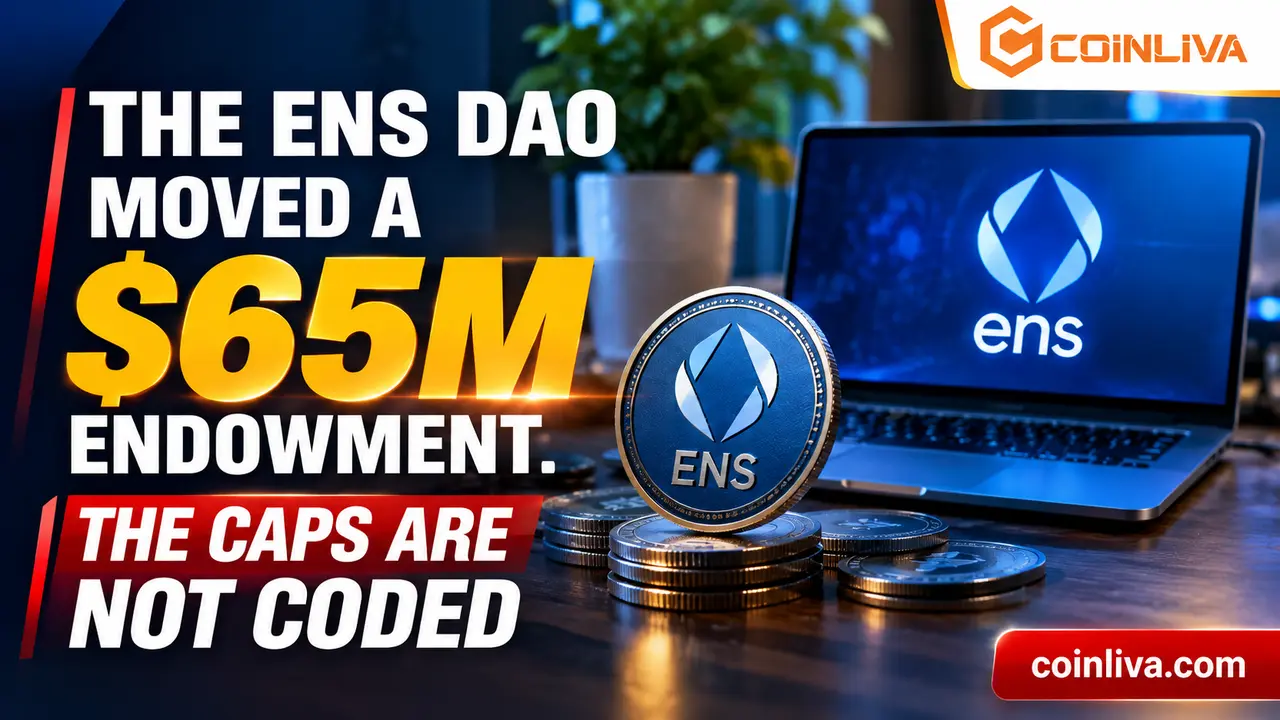
On Tuesday, the ENS DAO handed roughly $65 million to a five-person board. The vote on the "Next Era of ENS DAO" proposal closed at 1,269,420 tokens in favor and 480,690 against, clearing a one million quorum with room to spare. That endowment, grown over years from .eth name registration fees, now sits under a staffed foundation instead of the ENS DAO's own control. Getting there took about 1.75 million votes. ENS carries a 100 million token supply, and only 7.1 million of it is even votable.
A staffed board takes the keys
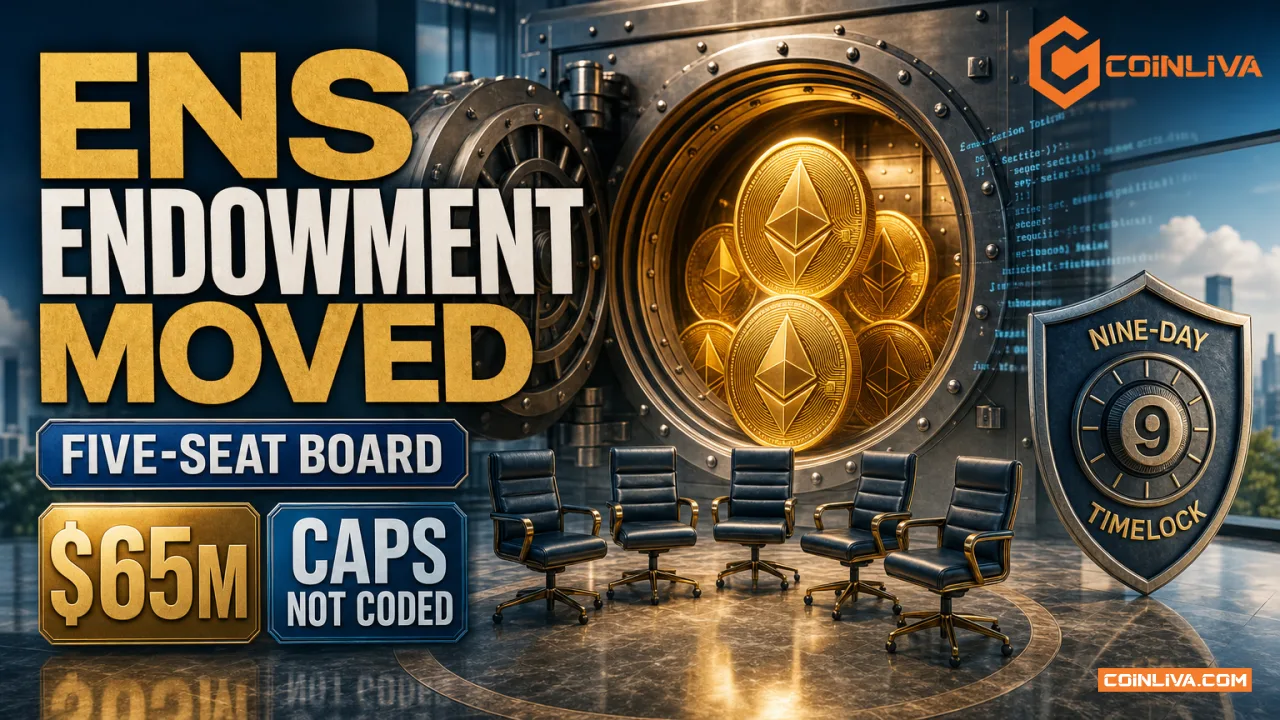
The endowment holds ETH and stablecoins, and karpatkey's Roles v2 module still runs its day to day positions. Ownership is the part that moved. The owner path now runs through a Foundation multisig, three signatures of five, behind a nine day timelock that a Security Council can veto with five of eight signatures through August 2028. A foundation gives the setup a legal home a bare DAO lacks. Alexander Urbelis takes the executive director seat. Nick Johnson, who built ENS, keeps a founder seat. Kartik Talwar, Brett Sun, and Anthony Leutenegger fill the independent seats, each paid 40,000 USDC a year on two year terms.
The limits that live in the prose
The proposal and the code do not fully agree, and one man who would know said so out loud. Alex van de Sande, who helped seat the current Security Council, moved from likely support to a no after reading the contract. The board addresses, he pointed out, never appear in the proposal text at all. The spending controls that delegates kept citing turned out to be unenforceable:
The draw limits, budget bounds, and the $500k standup cap exist in prose only. The executable enforces none of them.
Tokenholders did keep something back. The DAO's roughly $16 million operational wallet of ETH and stablecoins stays under existing controls, along with 54.6 million ENS, about 54.6% of supply. That wallet sat inside an earlier draft. Delegates forced it out before the vote.
| Guardrail in the proposal text | Written into the contract |
|---|---|
| $500,000 startup spending cap | No |
| Published budget bounds | No |
| Endowment draw limits | No |
| Nine day timelock on the owner path | Yes |
| Security Council veto, five of eight | Yes |
Not everyone was convinced
Fire Eyes DAO cast the largest single bloc against, 154,548 votes. Delegate Lefteris Karapetsas called the arrangement a pet foundation and said ENS had become, in effect, just ENS Labs. Another delegate, bcvfinance.eth, flagged that ENS Labs holds close to 4 million ENS, enough to swing most votes, while staying the largest recipient of ENS DAO funding even as revenue slips and costs climb. Governance fights like this one are not rare; Aave watched a risk provider walk away after three years over similar friction. The underlying numbers stay small. ENS name fees pulled in $228,329 over the past 30 days, roughly $4.98 million annualized, against a token market cap near $175 million. The distance between what a protocol earns and what its token trades for keeps turning up across the market, and ENS is now one more example of it.