
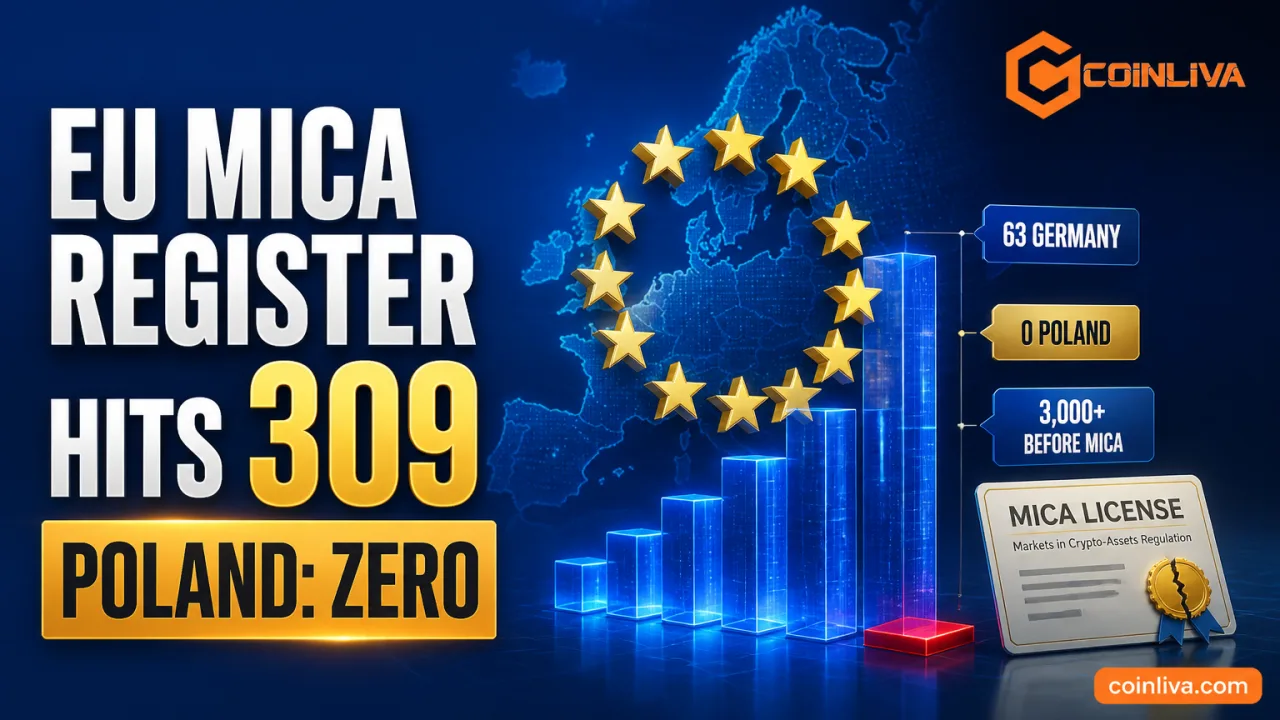
The ESMA register of MiCA license holders reached 309 firms on 27 July, according to CASP Tracker, an independent mirror of the official ESMA file. Twenty-six countries appear on it. Poland does not.
Four countries sit at zero in that register: Greece, Hungary, Romania and Poland. Three of them are slow. Poland is stuck, because the country still has no national law that would let anyone hand out a MiCA license in the first place.
Three vetoes, one supervisor with no statute
President Karol Nawrocki has rejected the Polish crypto-assets act three times, in December 2025, on 12 February 2026, and again in June. His objections centered on website blocking powers and fund freezes that could precede appeals. The KNF, Poland's financial supervisor, has no legal instrument to issue authorizations while that stalemate holds.
The scale of what is stranded depends on who counted. CoinDesk put Poland above 1,400 registered virtual asset service providers in late June and near 2,000 two days later. A Warsaw law firm tracking the same register counted roughly 1,300 in January. Even the low figure made Poland the largest crypto register in the bloc, against a European total CoinDesk placed above 3,000.
The business simply moves somewhere else. None of the Polish companies can receive the authorization in Poland, said Wojciech Kaszycki, chief strategy officer at BTCS.
Where the 309 licenses actually sit
Germany holds a fifth of the register on its own. The top five jurisdictions account for 167 of the 309 entries, or 54 percent, which leaves twenty-one countries splitting what is left.
| Country | MiCA licenses |
|---|---|
| Germany | 63 |
| France | 31 |
| Netherlands | 29 |
| Cyprus | 22 |
| Malta | 22 |
| Belgium | 2 |
| Poland | 0 |
Helms Advisory read the same file two days later and found 312 authorization records covering 306 unique active firms, the gap from duplicates and withdrawals. France, which has spent the past year backing a euro stablecoin push, sits second on both counts.
The wind-down deadline already passed
Polish providers without a CASP authorization were told to file a wind-down plan by 1 July. One Polish company, Morphic Financial Group, holds a MiCA license, and it obtained that license in another member state. The rest are applying through Lithuania, Latvia or Germany and passporting the service back home, which puts supervision of the Polish market in Vilnius, Riga and Frankfurt.
Firms that run out of runway do not always exit gently. Kulipa gave cardholders about an hour of notice before shutting its stablecoin card service this week. The vetoed Polish bill carried prison terms of up to five years for unlicensed operation, the same direction Russia took with its own criminal bill, so firms still trading in Warsaw sit inside a gap both sides expect to close.
ESMA has been adding names in batches since the cutoff: 37 on 3 July, 14 on 16 July, 15 on 27 July, with BNY's Belgian arm and BitPay among the latest. Poland contributed none of them, and the bill that would change that has not returned to the president's desk.