
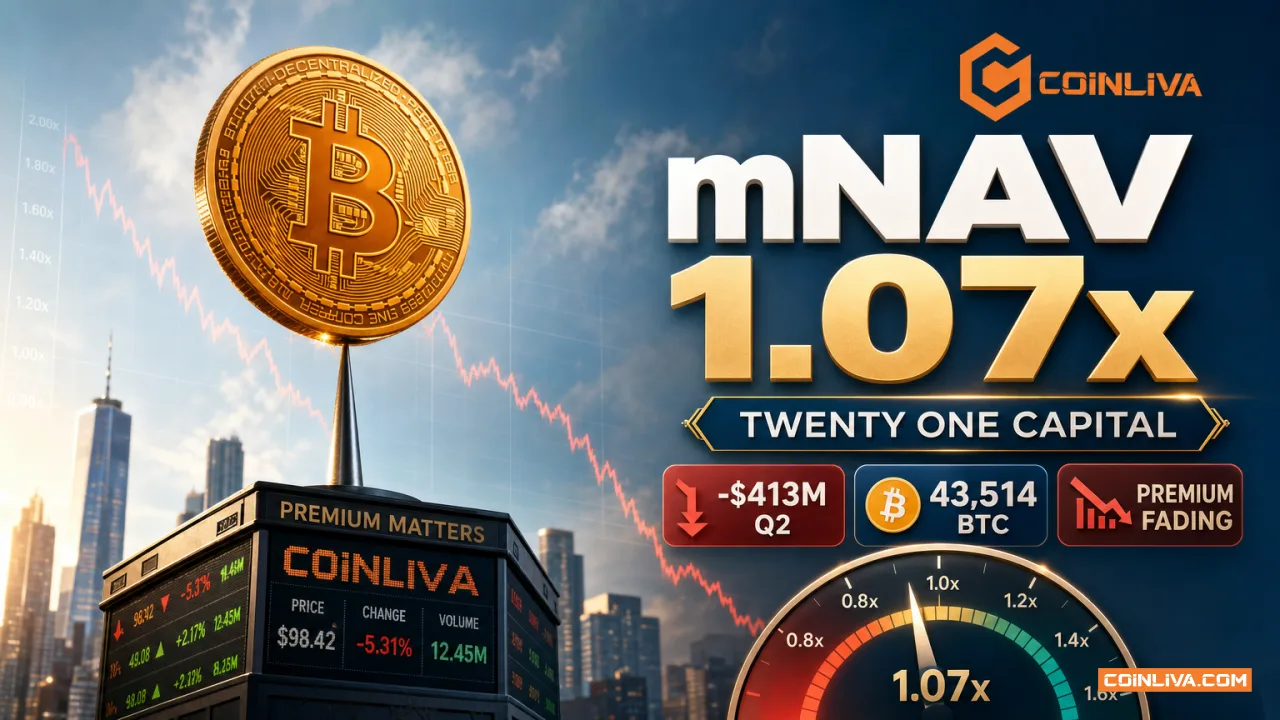
Twenty One Capital reported a $413.5 million loss for the second quarter on August 11. Almost all of it, $401.5 million, came from the bitcoin it holds losing value. That part is not the story. The number that should worry shareholders sits in a different line: the company's stock now trades at 1.07 times the value of its own coins.
That multiple, called mNAV, is the entire engine of a bitcoin treasury company. Trade above the value of your coins, sell fresh shares into that premium, and buy more bitcoin per share than you gave up. At 1.07x, the premium is nearly gone. Twenty One Capital holds 43,514 BTC worth about $2.76 billion, while the market values the whole company near $2.96 billion.
| Metric | Value |
|---|---|
| Bitcoin held | 43,514 BTC |
| Value of that bitcoin | $2.76B |
| Company market cap | $2.96B |
| mNAV (premium to coins) | 1.07x |
| Bitcoin per share | 0.000067 BTC |
| Q2 net loss | $413.5M |
| Loss from bitcoin repricing | $401.5M |
Zagury is saying the quiet part
Raphael Zagury took over as chief executive on July 20 and did not hide from the arithmetic. He told the sector that mNAV multiples should trend toward 1x, which is another way of saying the accretion trade that funded these vehicles is closing. When the person running the company concedes that, a pivot tends to follow. Twenty One is now steering toward bitcoin mining, bitcoin-backed lending, and outright acquisitions.
The template here is Strategy, the firm that made premium issuance famous, and even it has stumbled. When bitcoin dropped, Strategy chose that moment to sell. The strain is not unique. Bitmine set out to add hundreds of thousands of ETH and, in one recent stretch, needed 247,586 more and bought under 10,000.
What 1x actually means
At exactly 1x, a treasury company is a fund that owns bitcoin and little else. It cannot issue shares to grow the stack without diluting the holders it already has, because a new dollar of equity buys a new dollar of coins, no bonus. The premium was the bonus. Costs keep running regardless, and Twenty One posted zero operating revenue against a $10.57 million operating loss in the first quarter.
The pivot is the tell
The move into mining and lending is the admission. If you cannot stack coins by selling stock at a premium, you need a business that earns its own way. Mining is a grind, as BitFuFu showed in July, spending 357 bitcoin to mine 112. Lending against bitcoin carries the counterparty risk that buried the last cycle's biggest names. Twenty One Capital, backed by Tether and SoftBank, has the balance sheet to try all of it. What to watch next quarter is not the size of the paper loss but whether that 1.07x premium holds above 1 at all, because below it the pitch these companies were sold on stops working.