
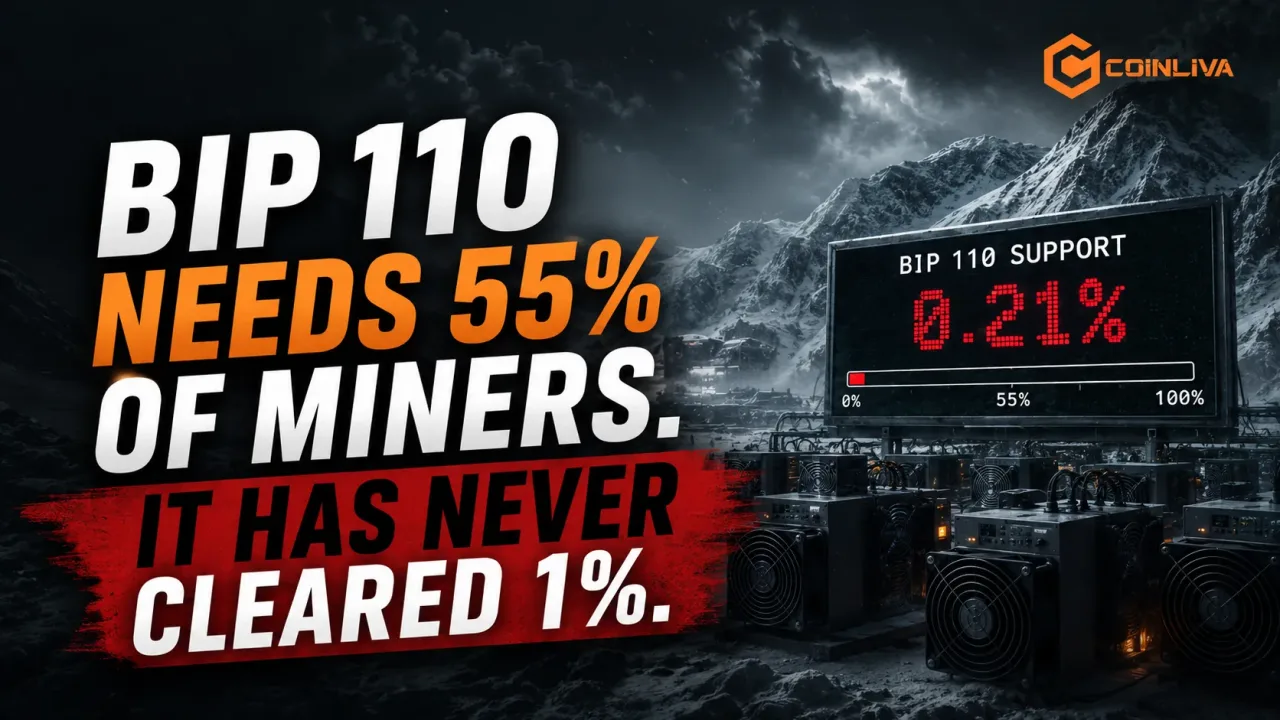
Michael Saylor spent his Saturday publishing an essay that promises 110 reasons to reject BIP 110. Adam Back has been arguing against it for a week. Jameson Lopp called its activation settings reckless. The fight has produced more noise than any Bitcoin governance argument in years, and it is a fight over a proposal that miners have almost entirely declined to touch. BIP 110 needs 55% of blocks to signal support. Cumulative signaling since May has never cleared 1%.
The deadline arrives in early August whether anyone signals or not.
What BIP 110 would actually change
BIP 110, titled the Reduced Data Temporary Soft Fork, reached Complete status on its GitHub listing on June 25. That label means the authors finished their planned work and recommend adoption. The BIPs repository is explicit that publication establishes nothing about community agreement.
BIP 110 would add seven consensus restrictions aimed at non-financial data. OP_RETURN outputs would be capped at 83 bytes, many pushed payloads and witness items at 256 bytes, and Taproot control blocks at 257 bytes. Spending undefined witness and Tapleaf versions would be blocked, the Taproot annex prohibited, and certain Tapscript opcodes and branches rejected. Coins created before activation stay under the old rules. The restrictions expire automatically about a year after they take effect, which is where the word temporary comes from.
BIP 110 targets Ordinals, Runes, and the broader practice of storing arbitrary data on Bitcoin. Backers argue this activity inflates storage costs for node operators and pulls the network away from payments. The specification itself concedes something worth sitting with: the rules raise the cost of embedding data rather than preventing it. Developer Peter Todd made the point physically by packing the full text of the proposal into a transaction that complies with the proposal.
The threshold was lowered, and it is still not close
Most Bitcoin soft forks activate under BIP 9, which asks for 95% of blocks in a difficulty period to signal readiness. BIP 110 uses a user-activated path with the bar set at 55%, or 1,109 blocks out of 2,016. Miners signal by setting a bit in the block version field. Almost none have.
| Measure | Figure |
|---|---|
| Signaling required to lock in | 55%, or 1,109 of 2,016 blocks |
| Standard threshold under BIP 9 | 95% |
| Peak cumulative signaling since May 1 | Roughly 0.3% to 0.4% |
| Hashrate behind it | Around 5 EH/s against a network near 940 EH/s |
| Major mining pools supporting | None |
| Voluntary lock-in deadline | Block 961,542, early August |
| Mandatory signaling window opens | Around block 961,632, near August 7 |
One monitor counted 38 signaling blocks out of more than 9,000 mined since May 1. The first came from Barefoot Mining through Ocean Pool on March 1, and no large pool followed. Node adoption tells a similar story, sitting in low single digits and carried almost entirely by Bitcoin Knots. Bitcoin Core has not endorsed the change and the submitted implementation has not been merged, which creates an awkward practical problem: according to Bitcoin Optech, miners running Core would need outside block-template software or would have to mine empty blocks to guarantee compliance after activation.
There is a straightforward reason miners have stayed away. Ordinals and Runes pay real fees, and those fees have become a meaningful share of block revenue at a time when the subsidy keeps halving. Asking miners to invalidate a paying category of transactions is asking them to shrink their own revenue line. That pressure is already visible in an industry where operators have been shifting capacity toward AI workloads to cover costs.
Saylor, Back, and the fork problem
Saylor's objection is about precedent rather than spam. His argument is that BIP 110 converts a disagreement over transaction purpose into a consensus rule, invalidating transactions that are currently valid and paying fees, and that the network has no way to read intent from data. A byte sequence that looks useless today could carry a financial application tomorrow. He also points at features deliberately left open for future upgrades, including the Taproot annex and undefined witness versions, arguing that closing them now narrows what developers can build later.
Adam Back, the Blockstream chief executive whose hashcash design sits in the Bitcoin white paper, went further and suggested that supporters who remain unconvinced should fork away on their own. That word carries weight here. A contested activation with single-digit support would not upgrade Bitcoin so much as spawn a minority chain, forcing exchanges and node operators to prepare for two networks.
Bitcoin has run this argument before. In April, developers proposed freezing dormant coins vulnerable to quantum attack, and the objection was the same one being made now, that consensus should not be used to decide whose valid coins remain spendable. Charles Hoskinson warned that version would function as a hard fork and strand millions of coins. Luke Dashjr, who supports BIP 110, has rejected calls to withdraw it.
What happens in August
The voluntary lock-in deadline lands at block 961,542. The mandatory signaling window opens around block 961,632, projected near August 7, with lock-in required no later than block 963,648 and activation around September 1 if the threshold is somehow met. On current numbers BIP 110 will not get there, and the likely outcome is a small minority chain enforced by a handful of Knots nodes while the rest of the network continues under existing rules.
That makes the volume of argument the more interesting data point. BIP 110, with under 1% miner backing, pulled in the largest corporate Bitcoin holder, the chief executive of Blockstream, and a long roster of developers on both sides. Bitcoin's governance has no vote to hold and no committee to convene, so disputes get settled by signaling, node choice, and public argument until one side runs out of room. The signaling in this case answered early. The arguing has kept going anyway, and it will keep going until the blocks that matter get mined in three weeks.