
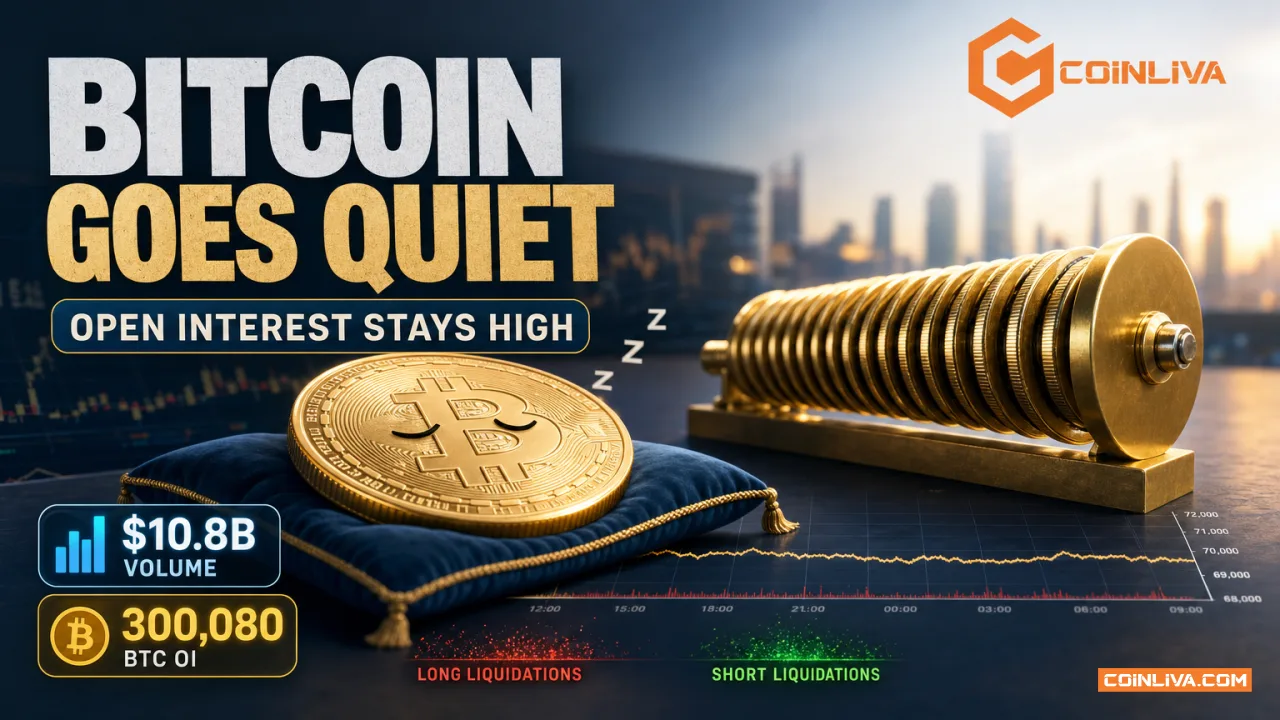
Bitcoin traded around $63,400 on Wednesday, roughly where it has sat for weeks. The number that matters is not the price. It is the volume behind it, and the open interest that refuses to follow that volume down.
Research firm K33 called the market a hibernation, and its data backs the word. The 30-day average volume for BTC/USDT perpetuals on Binance and Bybit sat at $10.8 billion as of August 11, the lowest reading since 2023. Only 5 percent of trading days since January 2021 have printed a quieter 30-day average, and those days clustered in late 2022 and 2023, the depths of the last bear market.
Spot is thinner still. Average daily bitcoin spot volume fell to $1.8 billion, down 18 percent in a week and the lowest weekly average since February 2024. Seven-day realized volatility touched 0.6 percent on Sunday, a reading last seen around Christmas. After Wednesday's inflation data, implied volatility compressed into its bottom decile.
Open interest held above its two-year average
Volume collapsed. Positioning did not. Average perpetual open interest ran at 300,080 BTC between June 1 and August 11, above the 2026 average of 288,000 and the 2025 average of 282,000. Traders walked away from the order books but kept their open interest on the table.
That mismatch is the whole story. K33's Vetle Lunde put it plainly: elevated open interest paired with volatile but moderate funding rates leaves the market open to liquidation-driven moves in either direction. Thin books do not absorb forced selling well, and the derivatives stack is not small either, with billions sitting in bitcoin options alongside the perpetuals. When positions this size unwind into a tape this quiet, the move tends to overshoot.
| Metric | Latest reading | How rare it is |
|---|---|---|
| Perp 30-day average volume | $10.8 billion | Only 5% of days since Jan 2021 lower |
| Spot daily volume | $1.8 billion | Lowest weekly average since Feb 2024 |
| 7-day realized volatility | 0.6% | Last seen around Christmas 2025 |
| Perp open interest, average | 300,080 BTC | Above both 2025 and 2026 averages |
| Long-term holder supply | Down 210,000 BTC | First weekly drop of 2026 |
Long-term holders blinked first
One line in the on-chain data stands out. Long-term holder supply fell by about 210,000 BTC last week, the first weekly decline of 2026. For most of the year, the wallets that ride through drawdowns had only added coins. Now a few are trimming, even as whale balances above 1,000 BTC hit a local high of 3.06 million bitcoin on August 8. Even corporate treasuries have started selling into the softness, with Strategy booking a loss on a bitcoin sale this month.
The range that keeps holding
Bitcoin has spent six straight months between $60,000 and $80,000, sitting near a 50 percent drawdown from its record. This is the same band where three supports broke earlier this summer, and the market has treated every push toward the edges as noise since. The macro backdrop did nothing to change that. July headline CPI came in at 3.4 percent, down from 3.5, with core at 2.5 percent, both matching forecasts to the decimal. An in-line print, as Bitget's Ryan Lee noted, neither forces a hawkish repricing nor hands the market a dovish reason to rally. So the range holds, the open interest sits, and the next real catalyst will land on order books too thin to cushion it.