
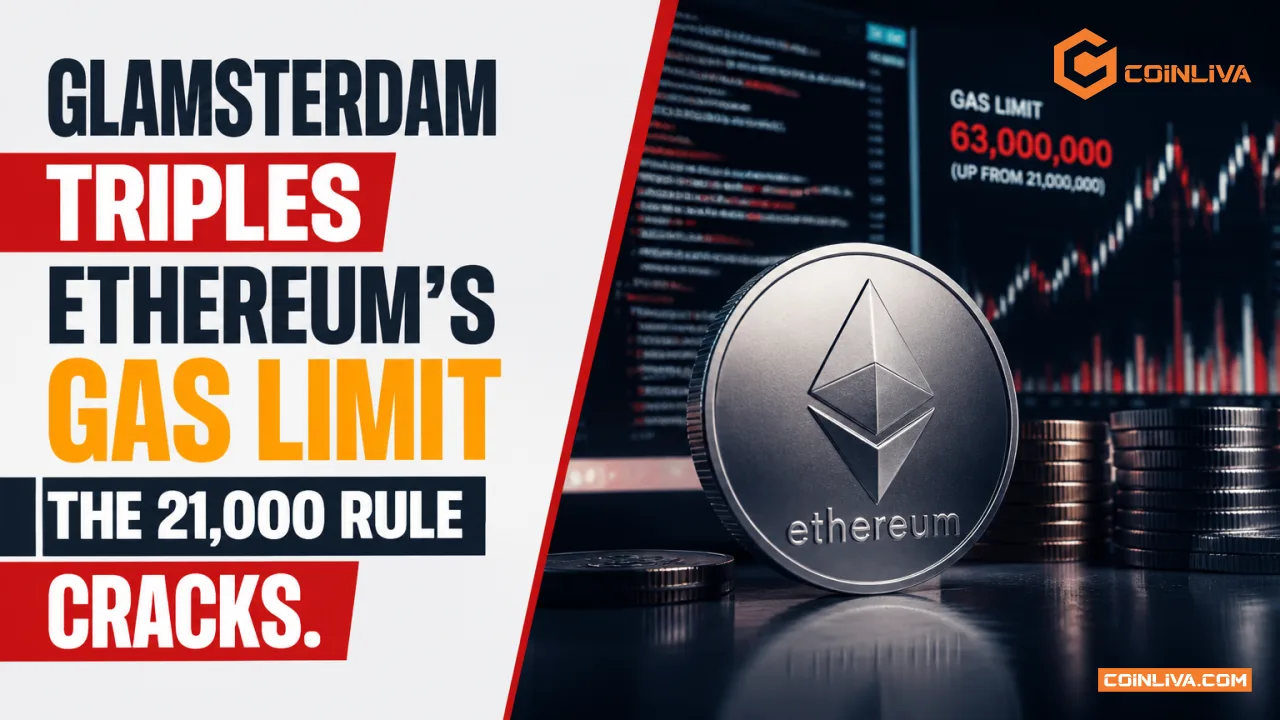
Ethereum's next hard fork, Glamsterdam, has been pitched as a throughput story. Glamsterdam targets a 200 million gas floor, roughly triple the network's current capacity of around 60 million, and the headlines have followed that number. On August 17 the Ethereum Foundation's Protocol DevOps team published something quieter alongside the launch of a new test network. A rule that wallets, block explorers and fee estimators have trusted since 2015 is about to stop holding in every case.
The rule is 21,000. That is the gas a plain ETH transfer has always cost, a constant so reliable that it got hardcoded into thousands of tools. Glamsterdam keeps it for most transfers and quietly retires it for the rest.
The one number every wallet baked in
The change comes from EIP-8037, one of ten proposals bundled into Glamsterdam. It adds a second gas dimension the network has never had, called state gas, meant to charge for the cost of permanently growing Ethereum's state rather than just for computation.
Send ETH to an address that already exists on chain and nothing changes. The transfer still costs 21,000 gas. Send it to a brand new address and the network now has to create a fresh account entry, and that creation carries its own state gas charge on top of the base fee. Same action, two very different prices, decided by whether the recipient has ever touched the chain before.
For a user this is invisible. For software that assumed a single fixed figure, it is the ground shifting.
What actually gets more expensive
The repricing reaches past transfers. Under the Glamsterdam parameters developers have been testing, operations that write new data to state climb sharply, while reads and existing accounts stay flat. The exact multipliers are still moving between test rounds, so the figures below are drawn from the parameter sets floated during testing rather than a locked final schedule.
| Operation | Cost today | Under tested Glamsterdam parameters |
|---|---|---|
| Transfer to existing account | 21,000 gas | 21,000 gas, unchanged |
| Transfer creating a new account | about 25,000 gas | roughly 7 to 8.5 times higher |
| Writing a new storage slot | 20,000 gas | close to 98,000 gas |
| Deploying a 24 KB contract | about 4.9 million gas | near tenfold, around 37 million |
Estimates for new account creation have landed anywhere from about seven times higher in one write up to roughly 8.5 times under an earlier parameter set, which is itself a sign of how live these numbers still are. A separate proposal in the same bundle, EIP-7954, pushes the other way and raises the maximum deployed contract size from 24 KiB to 64 KiB. The upgrade is not simply making things pricier. It moves where the costs sit.
Why the Foundation started emailing developers
The warning was blunt. Software that hardcodes a maximum gas value, or assumes Ethereum has one fixed gas ceiling, will break once Glamsterdam activates. The Foundation named the categories most exposed: wallets that pre fill 21,000 for a send, indexers that decode transactions against a fixed model, and gas estimators that quote a flat number before signing. If those tools underquote a transfer to a new address, the transaction simply fails.
This is why the message arrived with a testnet and not with mainnet. The Glamsterdam fork went live on the Platåberget test network on August 20, a short lived environment the Foundation opened for exactly this kind of shakeout. Teams can watch their estimators misfire there, where the only cost is a failed test transaction, and patch before real value moves.
A mainnet slot has not been set. Past forks spent two to four months seasoning on public testnets such as Hoodi before activation, which points to a launch in the back half of 2026. That gap is the point of the early notice. Glamsterdam's 200 million gas number will get the coverage, and it earns it, yet the change most likely to reach an ordinary user first is the one deciding whether their wallet still quotes gas correctly. For a walkthrough of where these fees come from, our explainer on how gas fees are priced and who collects them covers the mechanics this upgrade is rebuilding. The extra headroom is aimed squarely at rollups, the same layer where two trackers still disagree on Ethereum L2 value by 29 billion dollars, and it fits a longer run of protocol changes that includes Vitalik Buterin's push to make Ethereum transactions private.