
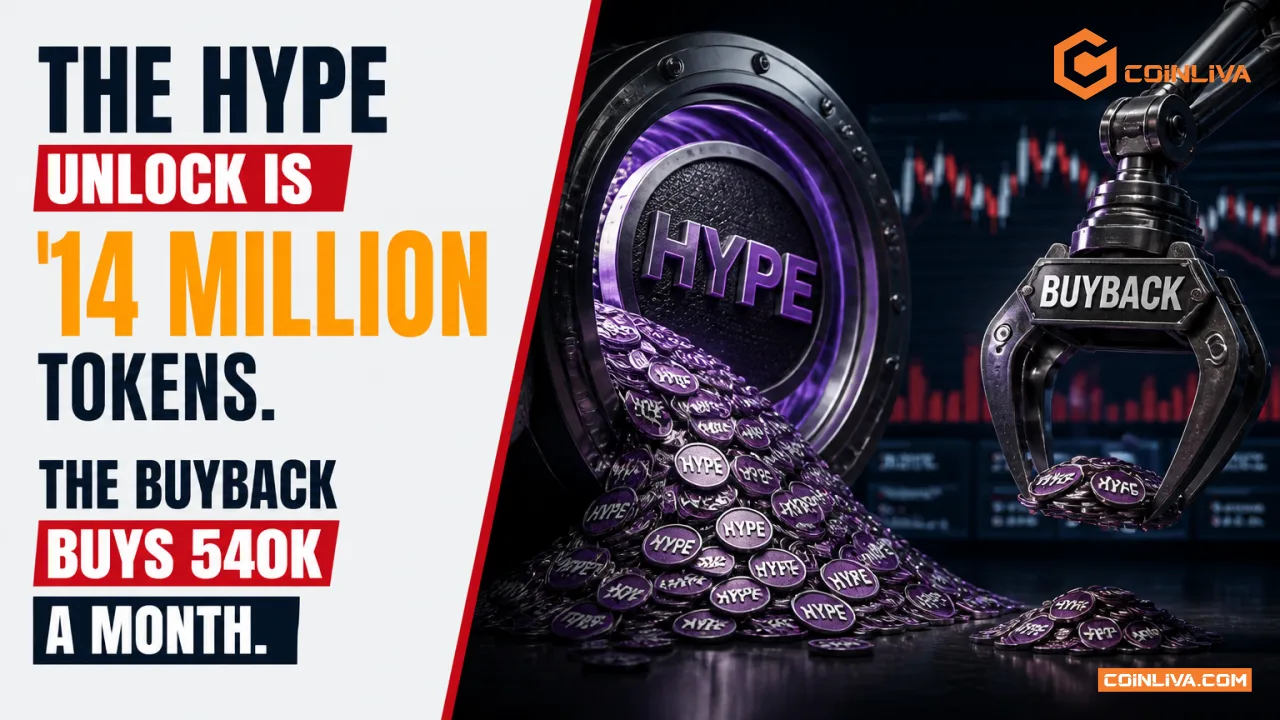
Hyperliquid's HYPE token touched a record $83.27 over the weekend, then eased back toward $77.50. The record is not the story this week. What lands on Friday is. On August 29 the protocol releases 14,175,778 HYPE in a single tranche, the largest of its monthly releases, and most coverage has rounded that HYPE unlock to a flat $1.2 billion.
The figure is real. It is also the least useful number in the story, because it bundles holders with every reason to sell together with holders who have none.
The headline reads $1.2 billion
At prices near the record, 14.18 million tokens come to roughly $1.2 billion. Against a market cap near $19.5 billion, the release is about one part in sixteen of everything HYPE is worth, and around 1.4% of the fixed one billion token supply. Set against a token that has been setting records all year, a slug that size in a day is the kind of event traders brace for. The bracing may be aimed at the wrong number.
Under half of it goes to early backers
Split the HYPE unlock into its buckets and the picture shifts. Early investors and insiders take 46.6%, worth about $560 million. A near-equal 46.3% is community allocation, tokens spread across users and rewards rather than a single desk. The Hyper Foundation keeps the remaining 7%.
| Recipient | Share | Approx value |
|---|---|---|
| Early investors and insiders | 46.6% | $560M |
| Community | 46.3% | $555M |
| Hyper Foundation | 7% | $84M |
The private, early-money slice is the part with the clearest reason to take profit into a record price, and it is under half the headline. Call it 6.6 million tokens rather than 14.18 million. The community and foundation shares can sell too. But folding all three into one $1.2 billion scare figure treats a foundation treasury and a venture fund as the same seller, and they behave nothing alike. That is the first thing the HYPE unlock coverage skips.
What the buyback buys in a month
HYPE carries a structural bid that most tokens lack. Hyperliquid routes nearly all of its trading fees into an Assistance Fund that buys HYPE on the open market, automatically, every day. That mechanism is a large part of why the token trades where it does, and it is the number the HYPE unlock has to be measured against.
Here is the pace. Over the last 30 days the protocol booked about $44 million in revenue, per DefiLlama, an annualized run rate near $726 million. Near $80 a token, that buys on the order of 540,000 HYPE a month. Now hold it against Friday. The early-investor tranche alone, 6.6 million tokens, is close to a year of buybacks landing at once. The full 14.18 million is more than two years of it.
The longer arc is starker. Since launch the fund has accumulated roughly 28.5 million HYPE, spending well over a billion dollars to get there. This one unlock is about half of everything the buyback has ever bought, released on a single Friday.
None of that means HYPE has to fall. Cliff unlocks are set months ahead, and vested tokens rarely all reach exchanges on day one, as the mechanics of vesting and cliffs tend to spread the impact. The figure worth tracking sits below the $1.2 billion on every screen. Watch the 6.6 million investor tokens, whether they move at all, and how much of the daily buyback is left to meet them once the week's fees clear.