
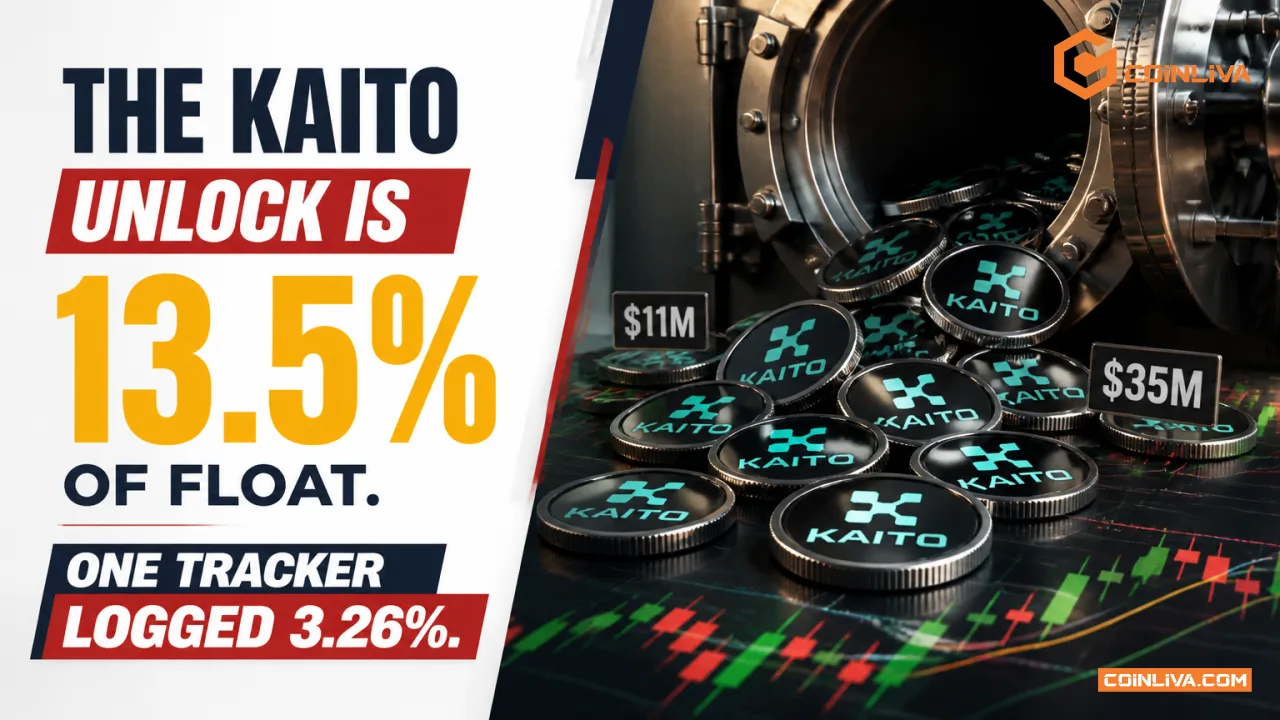
The one figure nobody disputes is 32.6 million. That is how many KAITO tokens reach the market on August 20, part of the project's scheduled monthly release. Everything else about the Kaito unlock depends on which tracker you open. One prices it near 11 million dollars. Another logged almost 35 million for the same event. The share of supply it represents gets quoted as low as 3.26 percent and as high as 13.5 percent.
The spread is not a rounding error. It comes from three different denominators and a price that has moved.
The trackers do not agree on the size
Here is how four sources framed the identical release.
| Source | Value quoted | Supply share | Measured against |
|---|---|---|---|
| CryptoRank | about 11M | 3.26% | max supply (1 billion) |
| Unlocks weekly digest | 12.17M | 7.63% | already-vested supply |
| Coinpedia (range) | 9.09M to 29.4M | 3.26% to 10.74% | mixed bases |
| cryip.co | 34.68M | 13.5% | circulating value |
Four trackers, one unlock, and a value range that runs better than three to one. A reader skimming headlines would come away with a wildly different sense of the risk depending on which tab loaded first.
Why the percentages split
Measured against the full 1 billion max supply, 32.6 million is 3.26 percent. Measured against what actually trades, it is far heavier. Kaito's circulating supply sits near 241 million tokens, roughly 24 percent of the total, and CoinGecko, CoinMarketCap and CryptoRank all report it within a hair of each other. Divide the release by that float and you get 13.5 percent. That is the figure a holder should track, because circulating supply is what sets the sell side.
The dollar gap is simpler still. Value is tokens times price, and Kaito's price has swung. The 35 million dollar headline was struck when the token changed hands near a dollar. It now trades around 33 cents. Same 32.6 million tokens, roughly a third of the dollar value. Priced today, the Kaito unlock is worth about 11 million. The trackers that quoted the larger sums never refreshed the price they multiplied by.
A thin float meeting a heavy release
Only a quarter of Kaito's supply has unlocked so far. That keeps its fully diluted valuation near 323 million while its market cap sits close to 80 million, and monthly cliffs like this one keep prying the two apart. July released about 17.8 million tokens, with roughly 6.94 million routed to core contributors. August is nearly double that count.
Daily volume has run anywhere from 27 to 56 million dollars across trackers this week, so an 11 million dollar release does not vanish into it. Whether the tokens weigh on price turns on who receives them and how quickly they sell, which no vesting schedule reveals. KAITO powers an attention-ranking network, the kind of token whose float and incentives shift as the protocol grows, so these releases will keep landing.
The pattern keeps recurring. When Succinct's PROVE unlock hit, the official docs and the trackers logged totals that were more than twice apart. Days before Akedo's release, traders were already positioning around it. The habit of reading a token by what sits under the price, the way Manta's revenue undercut its valuation, applies here too. The Kaito unlock's twist sits in the denominator rather than the token count. Pick the float, and August 20 ranks among the larger dilutions of the week in percentage terms, whatever dollar figure a given tracker prints beside it.