
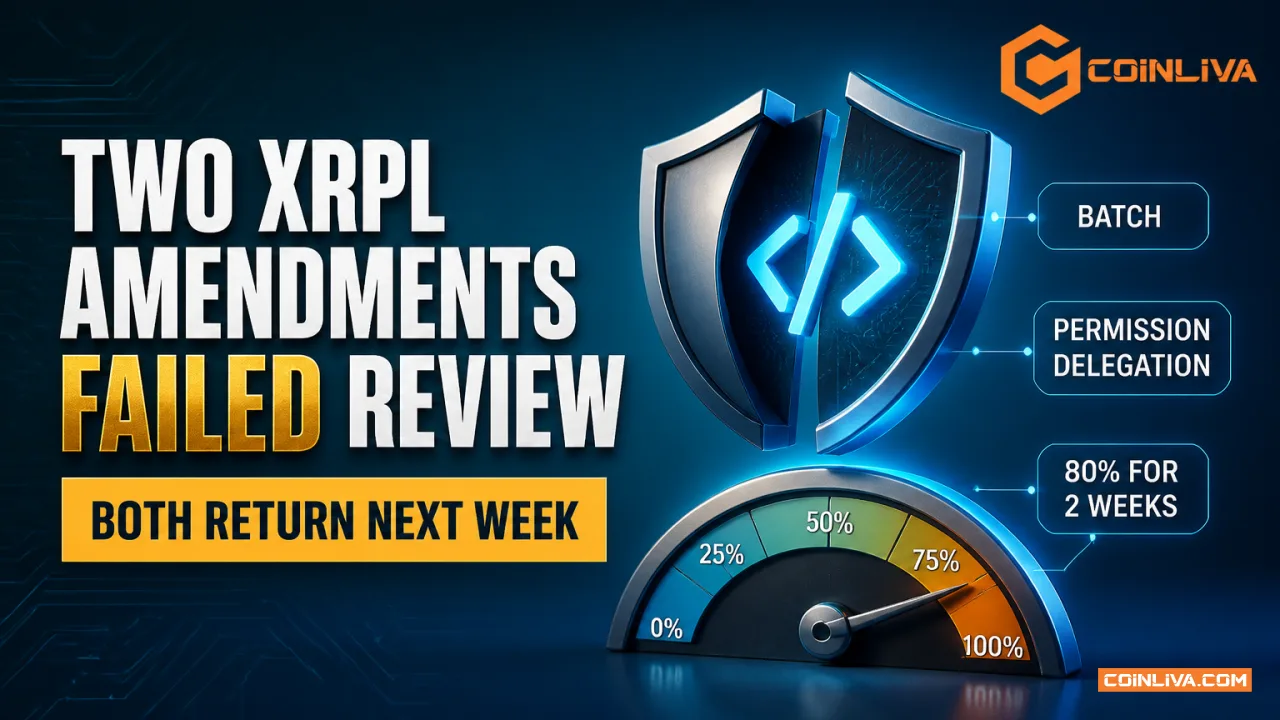
RippleX said on July 31 that xrpld 3.3.0 arrives the week of August 3, carrying five XRPL amendments into validator voting. Two of them have been here before. Both got pulled.
Jazzi Cooper, head of product at RippleX, pitched the release around tokenized assets. The five are Confidential MPT, Sponsored Fees and Reserves, Dynamic MPT, and rewritten versions of Batch and Permission Delegation. Those last two carry a history the XRP Ledger's own vulnerability disclosure reports spell out.
The bug that let one account sign for another
Batch groups up to eight transactions so they all succeed or all fail. It reached validator voting in February 2026. On February 19, researcher Pranamya Keshkamat, working with Cantina's automated auditing tool Apex, turned up a signature validation error inside the amendment code.
The disclosure report published February 26 rates the flaw critical. In the signer validation loop, whenever the code met an account that did not exist and whose signing key matched itself, it declared success and quit early. Every remaining signer went unchecked. An attacker could then run inner transactions for any victim account without holding its private keys.
Version 3.1.1 shipped four days later and marked Batch unsupported. Nothing touched mainnet, unlike the THORChain validator that drained $10.8 million.
Fees became the attack surface
Permission Delegation is narrower. One account hands a specific, limited authority to another without surrendering its signing keys, much like scoping a token approval instead of granting an unlimited one.
A community developer, tequ, reported that flaw on September 15, 2025. Permission got checked before the signature did. An account lacking permission received tecNO_DELEGATE_PERMISSION, and tec class errors charge a fee anyway. A malicious account could sign an invalid transaction offline, aim it at a victim, and the fee still landed. Repeat that enough and the balance empties. The fix disabled the amendment in 2.6.1 and switched the return code to terNO_DELEGATE_PERMISSION, which costs nothing.
| Amendment | Reported | Found by | Pulled in |
|---|---|---|---|
| Batch | Feb 19, 2026 | Pranamya Keshkamat with Cantina Apex | rippled 3.1.1 |
| Permission Delegation | Sep 15, 2025 | tequ, community developer | rippled 2.6.1 |
What the two week clock actually protects
XRPL amendments need more than 80% validator support sustained for two straight weeks. Slip under that line and the counter goes back to zero. The bar sits far above Bitcoin's, where BIP 110 needs 55% of blocks to signal support and has never cleared 1%.
That waiting period is why neither feature went live. Both were still counting when the disclosures landed, which left room for an emergency release.
The ledger's Known Amendments registry still files the two withdrawn XRPL amendments as obsolete, twelve entries deep. BatchV1_1 and PermissionDelegationV1_1 do not appear on it at all. Confidential MPT shows up only as ConfidentialTransfer, one of six entries still in development, well short of the 1,040 confidential transfers a second Zama has benchmarked.
Five XRPL amendments entering the window together makes this the widest test the rule has taken this year. Anyone trading around it should count on a fortnight of voting after release, and the XRP crowd has seen what gets built in the gaps around the ledger.