
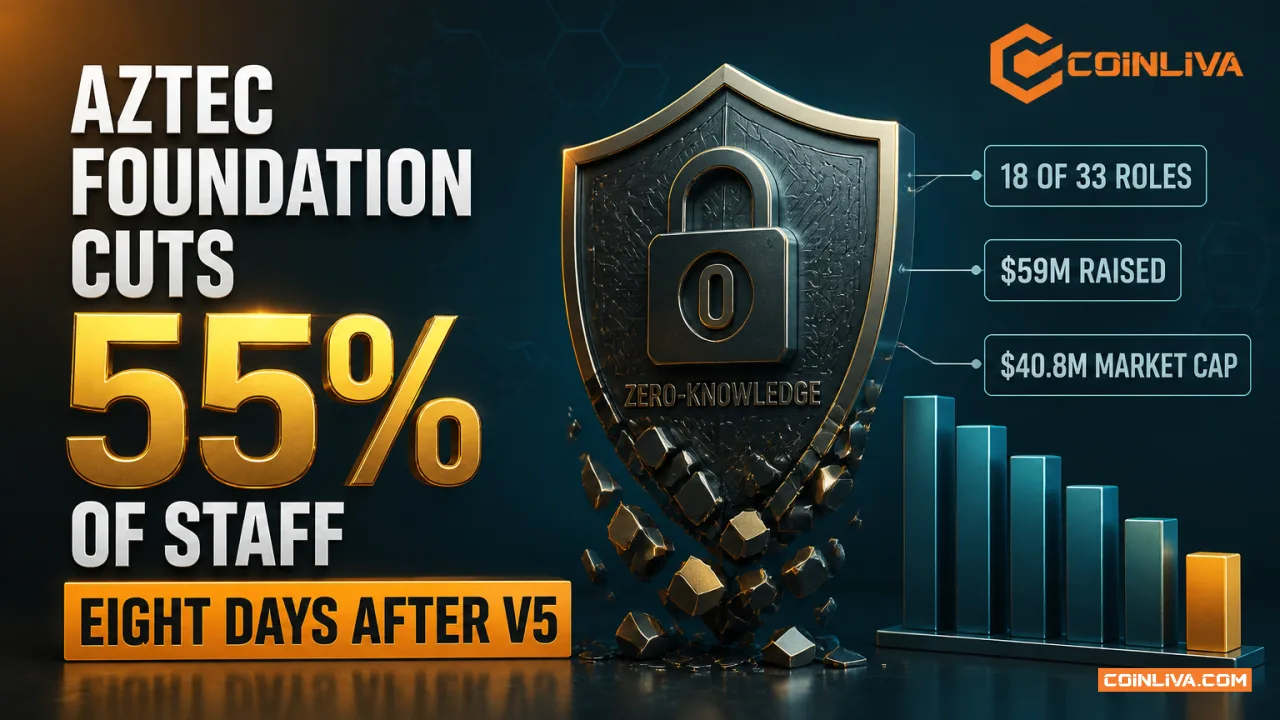
The Aztec Foundation cut 18 jobs on July 29, leaving 15 people where 33 had been. Co-founder Zac Williamson made the announcement himself. Cryptobriefing put the reduction at 55% of the organisation.
Eight days earlier, on July 21, the network had shipped Alpha V5. Aztec said the release more than halved the time a private transaction takes to process and brought fees down with it. The biggest upgrade since mainnet, then half the staff gone.
Williamson said the Aztec Foundation "remains well-capitalized to support long-term operational needs." Cryptobriefing noted no treasury disclosure backs the line. When the Ethereum Foundation moved 5,000 ETH into stablecoins, the transfer sat on chain for anyone to check. Nothing comparable exists here.
November's sale took $59 million from 17,000 wallets
Aztec sold tokens in November 2025 through Uniswap's Continuous Clearing Auction. Uniswap's write-up counts roughly 17,000 bidders across 191 countries and about $59 million raised, at a clearing price 60% above the floor. Ninety-six percent of bidders put in under $10,000, and the mean bid was near $4,000. Retail carried that book almost entirely.
The Aztec Foundation handles governance, security and grants. Aztec Labs, a separate company, builds the commercial product. Foundations funded by their own token have a mixed record on runway; the World Foundation's $65 million WLD sale showed how fast one becomes a seller.
What the market pays for the network now
| Measure | Figure |
|---|---|
| Raised across all rounds | Over $170 million |
| November 2025 community sale | About $59 million |
| AZTEC price | $0.01385 |
| Circulating market cap | $40.8 million |
| Fully diluted valuation | $143.3 million |
| 24 hour volume | $2.21 million |
| Circulating supply | 2.95 billion of 10.35 billion |
CoinGecko has AZTEC at $0.01385, a $40.8 million circulating market cap and a $143.3 million fully diluted valuation, ranked 494th. The November sale on its own raised more than the circulating supply is worth today. Take the fully diluted figure and the network still prices below the $170 million-plus that a16z, Paradigm and Vitalik Buterin committed across earlier rounds. Fully diluted valuation flatters young projects more often than it deflates them, which makes $143.3 million the generous reading.
Some 7.4 billion tokens, near 71% of the total, have not reached circulation yet.
A privacy chain still waiting on demand
Aztec reached mainnet in January 2026 and ran its token generation event in February. The Foundation was formally established on February 13, 2025, so this restructuring hits a body under 18 months old. Privacy work on Ethereum has never been short of engineering talent. What it lacks is traffic. Our earlier look at confidential transfers benchmarked at 1,040 a second while the live chain managed 20 caught that gap from another direction.
Measuring any of this is its own problem. Two major dashboards disagree about Ethereum layer 2 value locked by $29 billion, so a young privacy rollup's real usage is harder to pin down than its headcount. Cryptobriefing reported no market reaction in the token after the announcement, and daily volume of $2.21 million against a $40.8 million float leaves little room for one. Worth watching is whether the Aztec Foundation publishes a treasury balance behind the well-capitalized claim, and whether the 7.4 billion locked tokens get a release schedule before any move.