
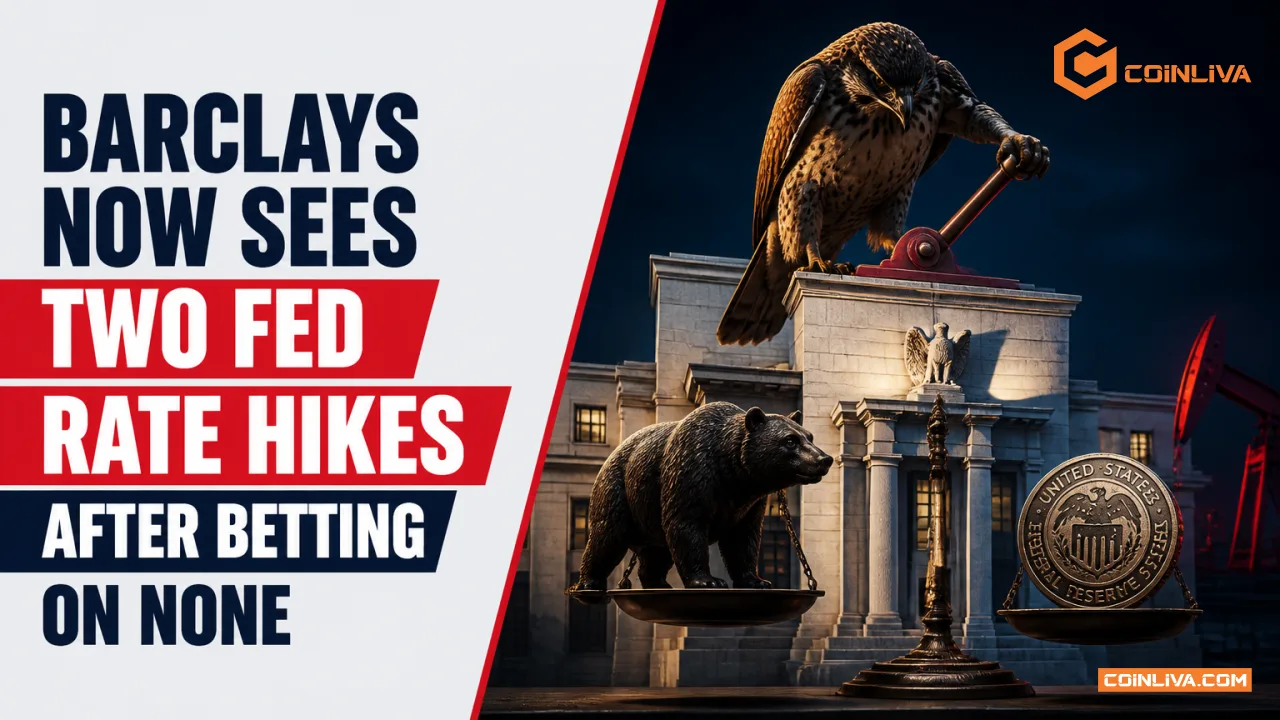
Barclays spent most of 2026 telling clients the Federal Reserve would sit still, with no change to policy rates at any point in the year. On August 31 the bank tore that call up and replaced it with two rate hikes, one in September and one in December, fifty basis points of tightening into a market that had been trading the opposite bet all year.
Bitcoin was near $77,500 when the note landed, down about 3% from its August 28 high of $81,478. The price barely moved. The move in the forecast was the larger event.
Barclays erased its own base case
The trigger was Kevin Warsh. The Fed chair used his Jackson Hole address to say the committee still has work to do on inflation, pointing to CPI and PCE readings that have stayed above the 2% target. Markets read it as a warning that the long-promised easing is off the table, and Warsh had already buried the rate-cut trade days earlier, a shift that triggered nearly half a billion dollars in liquidations.
Barclays now expects 25 basis points in September and another 25 in December, a full reversal of its earlier view that rates would not move at all in 2026. The bank is not the only desk turning hawkish. The size of its own about-face is the tell, because forecasters do not swing from zero to two without conviction.
The September number nobody agrees on
The odds of a September rate hike are the confusing part. Every desk points at the same CME FedWatch tool. Each reports a different number.
| Source, August 31 | Implied September hike odds |
|---|---|
| Coinotag, rate futures | 57% |
| CoinDesk, CME FedWatch | 58% |
| CoinGape, CME FedWatch | 61% |
| Forbes, CME FedWatch | 66% |
Some of the gap is timing, since the probability drifted through the session as traders repriced. Some is rounding and method. Either way the honest figure sits in the high 50s to mid 60s, a majority but well short of a settled outcome. CoinDesk made the point directly, arguing that a September rate hike priced at 58% is not a done deal, because the Fed usually only validates expectations once they climb past roughly 90%.
The next Fed meeting is a lean hike not a done deal.
That was Jim Bianco of Bianco Research, and the framing matters for anyone positioning crypto around September 16. A coin flip that the crowd trades as a certainty leaves room for a relief move if the Fed holds, or if it hikes once and signals it is finished.
What a rate hike in this cycle would even be for
Robin Brooks, now at Brookings and formerly the chief economist at the IIF, offered a reading that cuts against the panic. A rate hike here, he argued, would be closer to performative than punitive, a gesture meant to calm the Treasury market and defend the Fed's credibility on inflation rather than a real attempt to choke off growth.
If that holds, the mechanical hit to risk assets is smaller than the headlines imply. A single rate hike of 25 basis points, built to anchor long-term yields, can leave broad financial conditions loose, and loose conditions are what bitcoin has fed on for two years. The debasement crowd has leaned on that logic all year, even as bitcoin sat out much of 2026's macro rally.
Bitcoin already gave back August's easy money
The month was strong before Warsh spoke. Bitcoin climbed from around $63,000 to above $80,000 through August, a gain of more than 20%, and gold rose about 10% in the same stretch. Both surrendered ground after Jackson Hole, with bitcoin sliding 3% to trade under $77,000 and gold slipping in the same session. The two have moved as a pair through macro scares before.
Zoom out and the picture is harsher. Bitcoin is still down close to 29% from where it traded a year ago, so August was a recovery inside a longer drawdown rather than a breakout. The chart now leans on a double bottom near $77,382, with resistance around $79,400 and the August high at $81,478 as the level bulls need to reclaim.
The rate path is not the only inflation input in play. Washington's airstrikes on Iranian rocket launchers over the weekend pushed oil higher and added a second channel of price pressure on top of the Fed's own worries. Crypto has walked this road before, selling off on Middle East headlines even after the immediate risk cooled, a pattern that returned this summer when an Iran deal failed to lift prices.
September 16 is the pivot. If the Fed hikes once and frames it as insurance, the reaction could be muted or even positive, the way a resolved uncertainty often plays out. If Warsh signals that December is locked in too, matching the Barclays path, traders will have to price a real tightening cycle for the first time in this bull run. What matters is less the rate hike itself and more the language around the second one.