
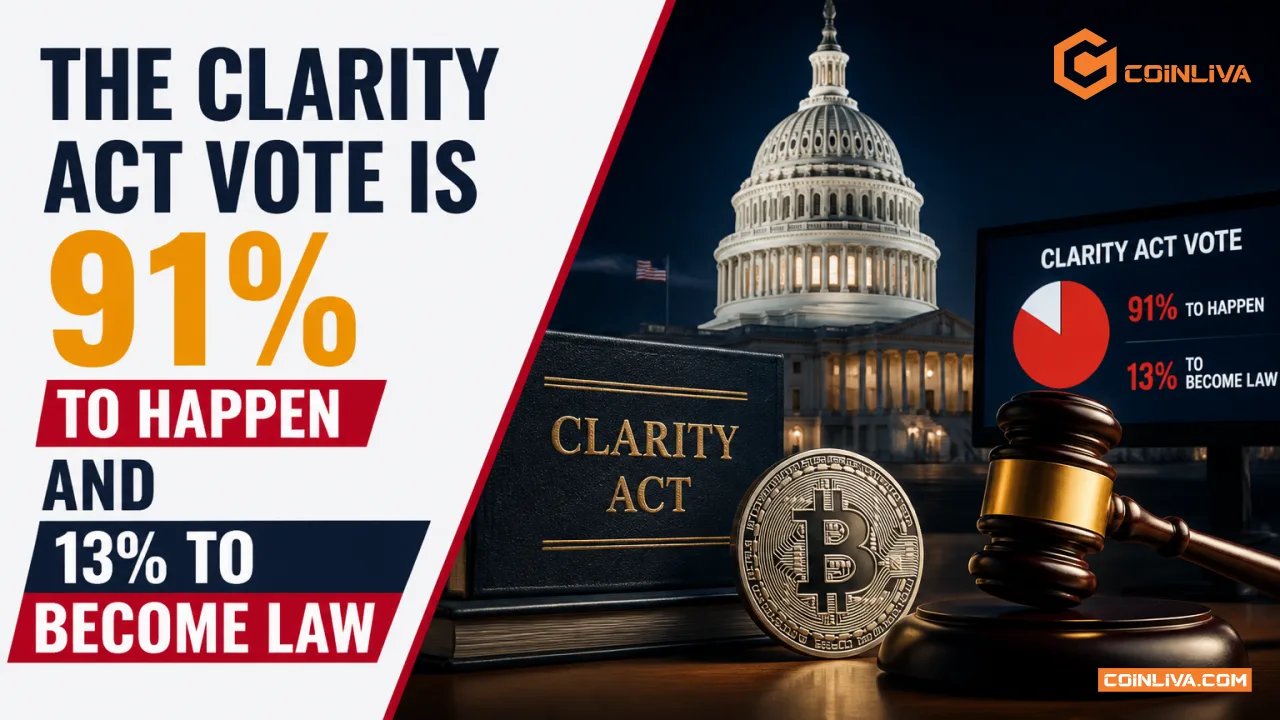
Two prediction markets are staring at the same bill and pricing opposite endings. Kalshi puts the odds that the Senate holds a CLARITY Act vote before October 1 at 91 percent. Polymarket puts the odds that the same bill becomes law in 2026 at 13 percent. Traders expect the senators to show up. They do not expect Congress to finish the job.
That 13 percent reading, logged on August 31 on a contract carrying about 11.5 million dollars in volume, is the lowest of the year. It was not always this quiet. The CLARITY Act cleared the House in July 2025 on a 294 to 134 vote, and for a while the Senate looked like a formality. Then the number started walking downhill and never turned back.
From 82 percent in February to 13 percent before a single senator votes
The decline was a slope, not a cliff. Polymarket had the bill at 82 percent in February. By the time the summer session opened it had already surrendered half of that, and each missed window shaved off more.
| Date | Polymarket odds the CLARITY Act becomes law in 2026 |
|---|---|
| February 2026 | 82% |
| July 21, 2026 | 43% |
| Late July 2026 | 24% |
| August 6, 2026 | 16% |
| August 31, 2026 | 13% |
The steepest drops lined up with the calendar rather than any single headline. Every recess that arrived without a floor vote told the market the same thing, and the money moved before the news did. By early August, when crypto.news reported the contract sitting at 16 percent after the chamber left for its break, roughly five million dollars had already changed hands on the main question, one of the most liquid regulatory bets crypto has produced.
Wintermute's 30 percent call now reads as the optimistic one
Back in April, Wintermute's Hammond put the bill's chances near 30 percent while the broader market still priced it far higher. At the time that looked bearish. Coinliva tracked the gap as it closed, and by mid-summer the market had walked all the way down to his 31 percent number. It did not stop there. The contract now sits at less than half of Hammond's spring estimate, which turns the CLARITY Act into a case where the loudest skeptic of the year has become the most hopeful voice in the room.
Research desks have moved with him. Galaxy Digital cut its passage estimate to 10 percent in August. Capital Alpha Partners marked the odds at 25 percent or lower. None of these are traders chasing a chart. They are the same shops that spend the year reading vote counts, and they have quietly converged on failure.
What the September 15 cloture vote actually needs
The Senate reconvenes on September 14, and Majority Leader John Thune filed cloture on the motion to proceed to H.R. 3633 before the recess, which sets up a procedural vote the next day. Cloture is the wall. It takes 60 votes to clear, which means Republicans cannot pass the CLARITY Act on their own numbers and need Democrats to cross over on the record.
Several unresolved fights are what those Democrats are being asked to swallow. The sticking points include ethics and conflict-of-interest language, stablecoin yield provisions that overlap with rules from the stablecoin law already on the books, the treatment of DeFi, the split of market authority between the SEC and the CFTC, and anti-money-laundering safeguards. That is a long list to settle on a single motion, and the last time the chamber tried to even open debate, Coinliva noted the same 60-vote threshold blocking the door.
The 91 percent and the 13 percent are not contradicting each other. Kalshi is pricing whether a vote occurs. Polymarket is pricing whether the CLARITY Act becomes law. A cloture vote can happen, come up short of 60, and send the whole effort back to negotiation, all inside the same afternoon. Traders are betting the motion gets called and then dies, which is the exact shape the odds have taken since spring.
For the market the practical read is narrow. A bill stuck in the Senate through 2026 does not hand the CFTC clear spot-market authority, does not settle the token classification question, and leaves builders under the same patchwork they have now. Attention has drifted elsewhere in the meantime, toward the Fed and a rate-cut bet that just wiped out 488 million dollars in open positions. The structural number is still in Washington. It is whether the September 15 count gets anywhere near 60, and every market with money on the question is betting it will not.