
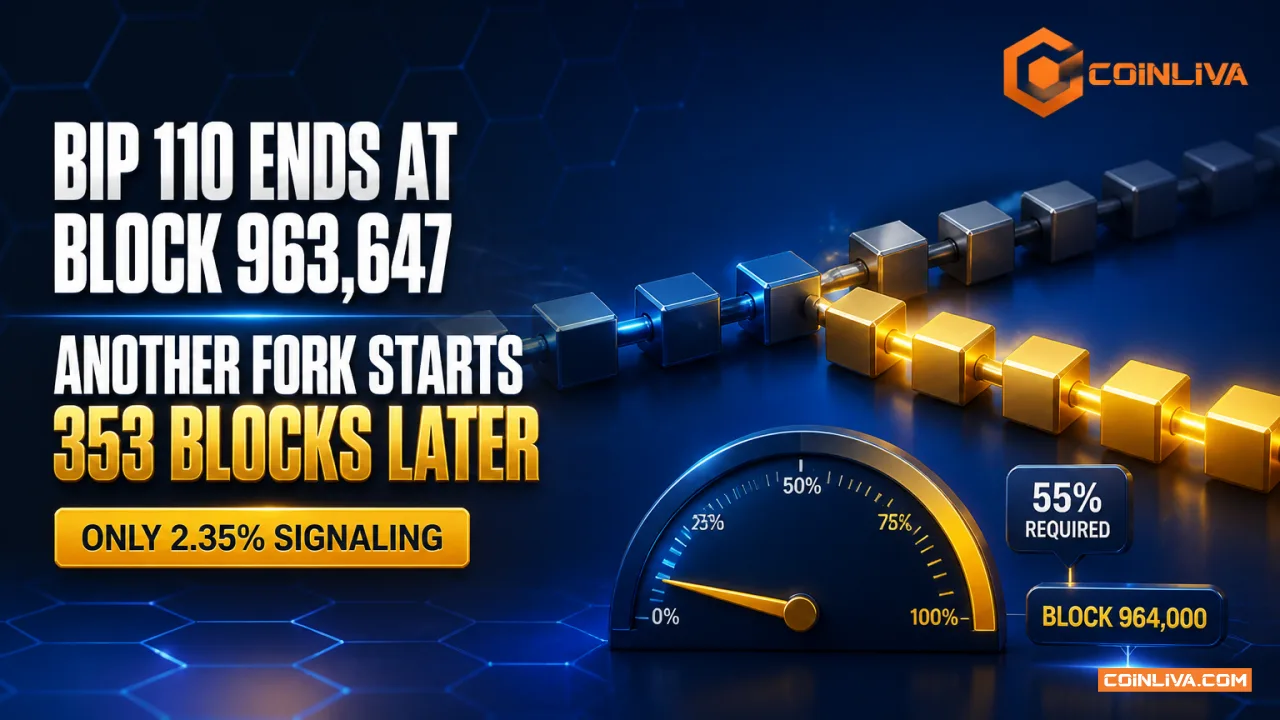
Bitcoin's data-limit soft fork has 21 signaling blocks behind it. It needs 1,109. Early Saturday the public BIP 110 signaling monitor read 21 of 894 mined blocks in the current retarget period, 2.35 percent against a 55 percent bar, with the chain sitting at height 960,509.
Twenty-one signals, 1,122 blocks left to fix it
Retarget period 476 covers blocks 959,616 through 961,631. That leaves 1,122 blocks. Climbing from 21 signals to 1,109 inside that space would mean 1,088 of the blocks still to be mined carrying the bit, roughly 97 percent of everything the network produces between now and the end of the window.
The distribution makes it worse. Michael Saylor, posting at height 960,561, counted 24 signals in 946 blocks and said every one came from a DATUM miner routing rewards through Ocean, with none from anywhere else. Coinliva reported the same shortfall in July, when signaling had never cleared 1 percent. Two weeks later the number has roughly doubled and changed nothing.
What turns on at 961,632
The BIP 110 specification describes a temporary soft fork by Dathon Ohm that caps scriptPubKey sizes, witness stack elements and parts of Taproot for about a year, then expires by itself after 52,416 blocks of enforcement. Activation runs on a modified BIP9 with the threshold set at 1,109 of 2,016 blocks, no time-based timeout, and a mandatory signaling period at blocks 961,632 to 963,647. Lock-in has to land by 963,648. After height 965,664 the deployment is dead.
Mandatory signaling is the part with teeth. Nodes enforcing the rules reject blocks that fail to signal, so a miner base parked near 2 percent walks into a window where most of the hashrate is producing blocks those nodes will not accept.
| Block | Blocks from 960,509 | What it marks |
|---|---|---|
| 961,631 | 1,122 | Retarget period 476 closes |
| 961,632 | 1,123 | Mandatory signaling opens |
| 963,647 | 3,138 | Mandatory signaling ends |
| 963,648 | 3,139 | Latest possible lock-in |
| 964,000 | 3,491 | eCash hard fork activates |
Block 964,000 asks nobody
The second August event has nothing to do with data limits. Paul Sztorc of LayerTwo Labs plans to fork the chain at block 964,000 into eCash, keeping SHA-256 mining, resetting difficulty once, and crediting every BTC holder a matching balance on the new chain alongside Drivechain-style sidechains. The contested piece is the dormant supply. AMINA Bank's July 30 research note puts the reassignment at roughly 500,000 coins tied to Satoshi Nakamoto, drawn from the 1.1 million BTC sitting in those early addresses, much of it in scripts that have already exposed a public key.
Sztorc needs no window, no threshold and no pool cooperation. A spin-off of this shape happens when somebody runs the software, and 964,000 sits 353 blocks past the last height at which BIP 110 can lock in. Anyone holding BTC at an exchange through late August has a duller question to answer first, which is whether their venue intends to credit a spin-off chain at all, and most of them have said nothing so far.