
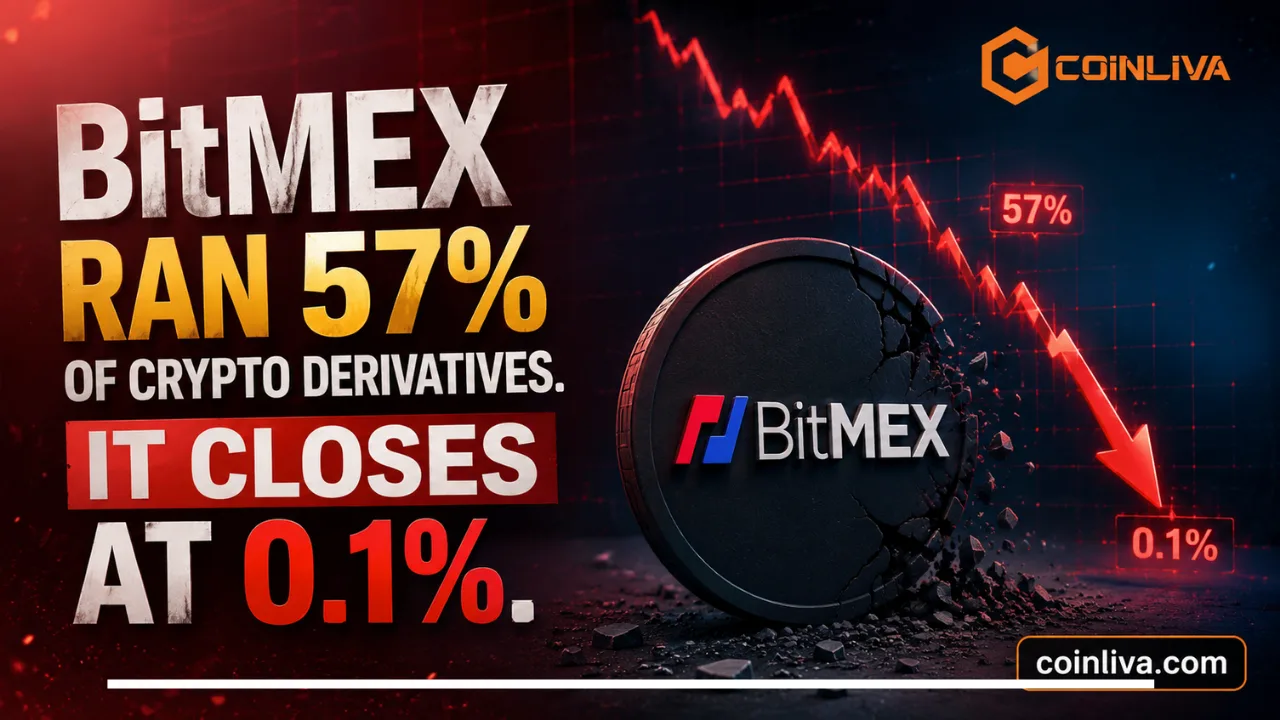
BitMEX told account holders on Thursday that it will stop trading on 23 September at 04:00 UTC. The exchange that built the perpetual swap, the contract that now carries most of the margin risk in crypto, is winding down after 11 years. New account registrations were switched off the same morning.
The closure notice reads like an orderly exit. The trading data reads like something that finished a while ago. BitMEX turned over roughly $137.7 million across its derivatives markets on Thursday, according to CoinGecko. Across crypto futures as a whole, 24-hour volume that day sat near $147 billion, according to CoinDesk. The venue that invented the instrument was handling about a tenth of one percent of it.
Peak share was 57 percent
That gap is the part worth writing down, because the two numbers used to be much closer. At its height in 2019 BitMEX cleared more than $1 trillion in annual volume and held roughly 57% of the global crypto derivatives market. In July 2018 daily turnover reached $8 billion and more than a million bitcoin changed hands inside a single session, a record for the industry at the time.
Thursday looked different. The $137.7 million figure was itself inflated by the announcement, up 28% on the previous day as traders reacted to the news. XBTUSD, the original bitcoin perpetual, accounted for $109 million of it. The other 104 listed pairs split what was left.
| Measure | BitMEX at its peak | BitMEX on 23 July 2026 |
|---|---|---|
| Daily derivatives turnover | $8 billion (July 2018) | $137.7 million |
| Annual trading volume | above $1 trillion (2019) | not disclosed |
| Share of crypto derivatives | roughly 57% (2019) | roughly 0.1% of the day's futures turnover |
| Busiest contract | XBTUSD | XBTUSD, at $109 million |
Everyone else copied the contract and kept building
A perpetual swap never expires. A funding payment passes between longs and shorts at fixed intervals and drags the contract back toward spot, which is what lets a futures position stay open indefinitely. Arthur Hayes, Ben Delo and Samuel Reed shipped that design in 2016. Every serious venue copied it.
Copying was the easy part. Binance, Bybit, OKX and Gate then wrapped spot markets, fiat rails, staking, payment cards and institutional custody around the derivatives desk, listed hundreds of assets, and pulled the market makers across with deeper books. BitMEX kept selling 100x margin to speculators and added comparatively little else. By the start of 2026 its daily derivatives volume had fallen to the $300 million to $350 million range while rivals were doing tens of billions.
Then the on-chain venues arrived and took the next slice. CoinGecko's Q2 2026 industry report puts centralised perpetual futures volume down 10% to $12.7 trillion for the quarter, with decentralised platforms still gaining. Hyperliquid moved from a 6.9% share of aggregate perpetual open interest in late May to 9.3% by early July, and DefiLlama data put its total open interest near $11.07 billion on 13 July. It now sits second by open interest behind Binance, in the product category BitMEX created and then spent six years handing over.
The regulatory bill came due years before the closure
None of this happened suddenly. US authorities charged BitMEX in 2020 over anti-money-laundering failures, and the company pleaded guilty in 2024 to Bank Secrecy Act violations covering 2015 to 2020. Hayes, Delo and Reed resigned shortly after the criminal charges landed. Liquidity, market makers and larger accounts moved to venues without the legal overhang, and they did not come back when the cases closed.
The executive layer went last month. Chief executive Stephan Lutz, chief financial officer Ina Steiner and chief growth officer Raphael Polansky all departed, with former general counsel and operating chief Peter Wilkinson taking over. Three weeks later the exchange announced it was closing. HDR Global Trading Limited, the Seychelles parent that ordered the strategic review, has not said what the review concluded, and BitMEX declined to comment beyond the notice.
Eight weeks to unwind, and nobody is sure how much is left
Getting a clean read on what BitMEX still carries is harder than it should be. CoinGecko's exchange page showed about $541 million in open interest on Thursday. Counts published earlier this year put the figure under $200 million. A single line in CoinGecko's own table, the XMRUSDT contract, is listed at $274 million of open interest against $4,473 of daily volume, which is roughly half the exchange total sitting in a market that barely trades. Aggregate Monero open interest across tracked venues is reported at $28.3 million by Coinalyze, so at least one of those readings is wrong.
Coinliva could not resolve the discrepancy before publication, and a range is the honest answer. Whether the real figure is $200 million or $541 million, it sits against a futures market holding roughly $111 billion in outstanding contracts. Everything that has to be unwound before September is small enough that the wider market will not feel it leaving.
| Date | What happens |
|---|---|
| 23 July 2026 | Closure announced. New registrations stopped. Users urged to close positions and withdraw. |
| 26 August 2026 | Risk limits applied. No new positions can be opened, existing exposure can only be reduced. |
| 23 September 2026, 04:00 UTC | Trading stops. Any remaining open contracts are force closed. |
| After 23 September | Wallet balances and transaction history stay viewable. Assets left behind are charged $50 a month or 1% a year. |
BitMEX has flagged two practical risks around the exit. Bitcoin network congestion could slow withdrawals if everyone moves at once. The platform has also warned users about phishing and fake expedited withdrawal offers, of which there will be plenty over the next eight weeks, and says no fast-track service exists. Additional withdrawal reviews and network restrictions may be applied during the transition. Its proof of reserves shows customer assets exceeding liabilities.
One claim survives the wind-down that most of its 2014 contemporaries cannot make. BitMEX never lost customer funds to an intrusion or an exploit across the full 11 years, through the enforcement actions, the executive churn and the slow bleed of market share.
Hayes has not commented publicly on the closure. His most recent post on X was dated 16 July, a week before the platform he co-founded told everyone to take their money out.