
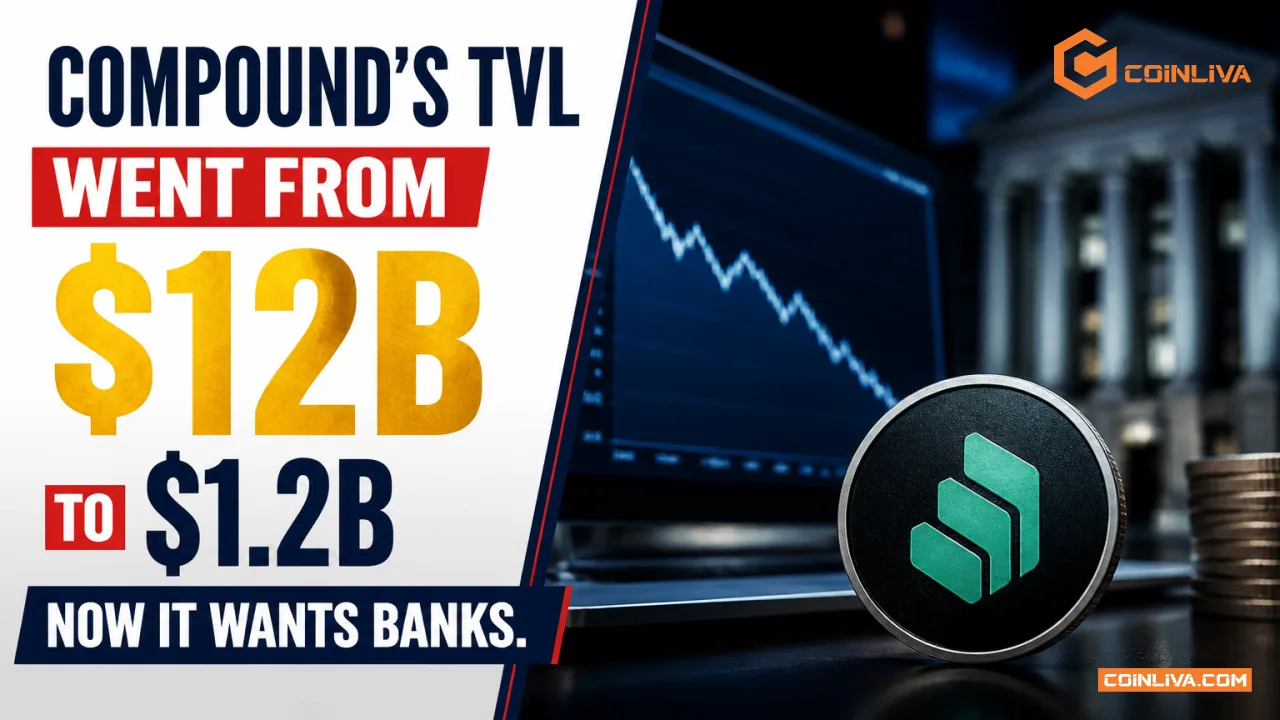
Compound helped kick off what the market later called DeFi Summer. Back in 2020 its lending pools were where a lot of people first borrowed against their crypto with no bank sitting in the middle. This week the protocol's governance holders approved the biggest budget in Compound's history, about $52 million, and the roadmap it pays for leans toward a customer those early users were built to avoid: the institution.
COMP is down about 98 percent and barely moved on the news
Start with the token, because it frames the rest. COMP trades near $18. That is roughly 98 percent below the $854.45 it printed on May 11, 2021, at the top of the last cycle. In June this year it fell to an all-time low of $14.86 and has scraped along near that floor since. The funding vote produced a bounce of about 10 percent in a day, on volume of roughly $33 million. For a token once treated as a DeFi blue chip, that is a quiet response to the largest spending plan it has ever green-lit.
| Metric | 2021 peak | August 2026 |
|---|---|---|
| COMP price | $854.45 | about $18 |
| Total value locked | about $12 billion | about $1.2 billion |
| All-time low | $14.86 (June 25, 2026) |
There is no fresh supply to blame. COMP is fully diluted, all 10 million tokens already in circulation, so nobody can point at an unlock schedule. What drained away was demand, and it has not come back. Other lending venues feel the same pull. Curve's LlamaLend, an active market, earns about $528 a week for the trouble.
The $52 million is a bet on institutions, not the crowd that built it
The budget funds a deliberate turn upmarket: real-world asset support, credit rails built to satisfy financial regulators, tooling to embed Compound's markets inside larger firms, and a wider set of partner integrations. The DAO paired the money with a new leadership bench pulled from Coinbase Custody, Maple Finance and Near, led by Aaron Schnarch as executive director. Compound describes it as the largest development program it has ever funded.
Without the marketing, it is an admission. Lending to retail on-chain no longer covers the ambitions it did five years ago, so the protocol that taught retail how to borrow is now building for the desks on the other side of the trade. The real-world asset push carries its own warning, because much of that market barely trades. Coinliva has covered how eleven tokenized products worth $100 million each sit in a single wallet, dormant.
Half a trillion in volume, a $180 million token
Two numbers frame the mismatch. Compound says its markets have handled around $480 billion in deposits and borrowing since 2018, with no bad debt across that whole span. Its market cap sits near $180 million. The plumbing moves real money and loses none of it, while the market prices the right to govern it at less than a mid-size startup raises in a single round.
The locked capital tells the same story from another angle. Deposits in Compound peaked around $12 billion in 2021 and now sit near $1.2 billion, a slide of roughly 90 percent. Money leaving a lending protocol is not unique to Compound. Aave took the largest capital exit in its history earlier this year. The difference is what each is doing about it. Compound's answer is to spend $52 million and hire for a market it has never really served, and the first institutional products are promised within weeks.