
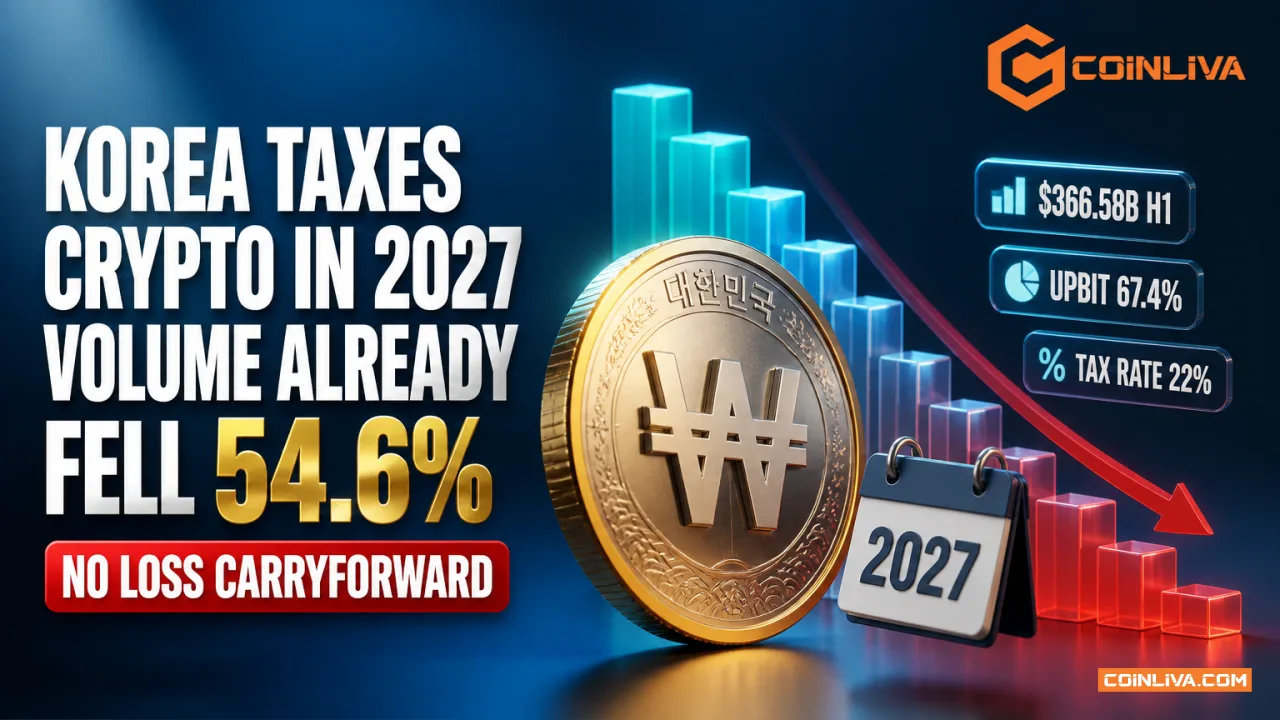
South Korea's crypto tax does not take effect until January 1, 2027. The selling started well before that. Five licensed Korean exchanges handled $366.58 billion in the first half of 2026, down 54.6% from the same stretch of 2025, on figures compiled by the analytics firm NexBlock.
Deputy Prime Minister and Finance Minister Koo Yun-cheol confirmed the timetable on July 29 in front of the National Assembly's finance and economy planning committee. Coinliva wrote about the four earlier postponements back in May, when a fifth still looked plausible. Nobody offered one this time.
A 54.6% drop before the first won changes hands
July gave no relief. The five exchanges cleared 17.34 trillion won between the 1st and the 27th, 16.9% under June's total. Korean retail traders had already started unwinding positions earlier in the year, and the deadline has given that drift something firm to run from.
The rate is 22%, built from a 20% national levy and a 2% local surcharge, and it bites on annual gains above 2.5 million won, roughly $1,740. Seoul classifies the proceeds as other income rather than capital gains. First returns come due in May 2028.
Losses in one year stay stranded
The provision drawing the loudest complaints is the one that was left out. As drafted, the crypto tax carries no loss carryforward. A trader down 10 million won in 2027 who makes 10 million won back in 2028 still owes the full 22% on the second year. People Power Party lawmaker Kim Sang-hoon put that to the ministry directly at the July 29 hearing, warning that activity would drift toward overseas venues, decentralised platforms and peer-to-peer markets.
His party colleague Song Eon-seok filed a bill in March to scrap the crypto tax outright. It went to subcommittee and has sat there since. Meanwhile the exchange body DAXA says the anti-money-laundering reporting rules arriving alongside the tax will strain compliance systems at the smaller venues, the same venues that were already struggling before any of this. Regulators fined Coinone $3.5 million earlier this year over customer protection failures.
Upbit took 67.4% of a smaller market
Concentration ran the other way. Upbit's 11.69 trillion won in July gave it 67.4% of Korean trading, up from 62.3%. Bithumb slipped to 27.1% on 4.71 trillion won, down from 30.7%. Coinone, Korbit and Gopax split what was left, which is why OKX and Korea Investment were circling a Coinone stake in the first place. A market losing half its turnover is consolidating into its biggest venue at the exact moment the compliance bill arrives.
Korea is not the only government setting a hard date and watching behaviour shift ahead of it. Vietnam's fine regime opens September 1 with no licensed exchange in place. Moscow's mining ban runs to 2032. The next marker in Seoul is the autumn budget session, where Song's repeal bill either gets a hearing or stays buried, and August volume will be sitting on the table by the time it does.