
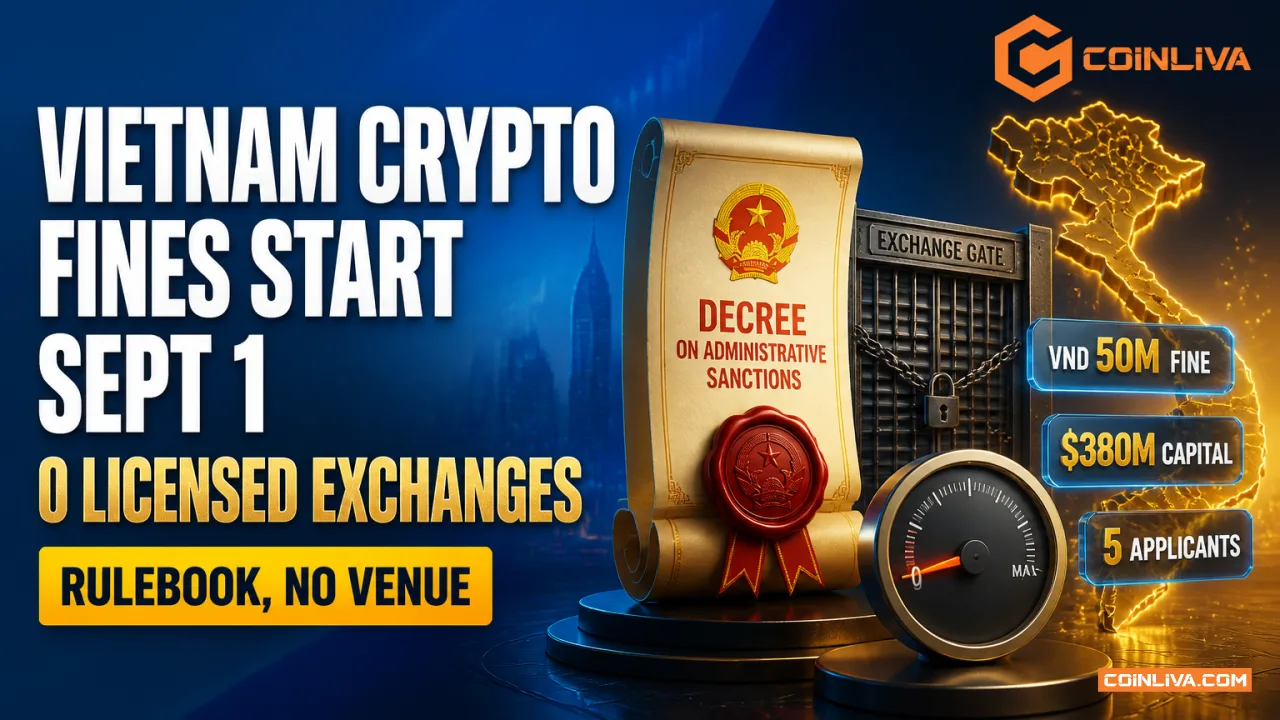
Vietnam picked a start date for its first crypto penalties, and it lands before the market those penalties point people toward. Decree 284/2026/ND-CP takes effect on September 1. From that Tuesday, a resident who trades through a platform without a Vietnamese license can collect an administrative fine. The new Vietnam crypto rules never name Binance or OKX. They do not need to. Those are the venues most of the country already uses, and no exchange inside Vietnam holds a license yet.
Deputy Prime Minister Nguyen Van Thang signed the decree on July 16. Coverage since then settled on one figure, $1,900, and moved on. The more useful number sits in the licensing file, and that number is zero.
What Decree 284 punishes
The decree sits underneath Resolution 05/2025/NQ-CP, the five-year pilot the government issued in September 2025 to build a legal Vietnam crypto exchange sector. That pilot runs to September 2030. Resolution 05 built the market. Decree 284 supplies the stick.
Several behaviours carry money penalties under the Vietnam crypto decree. Trading through an unlicensed venue sits at the bottom of the scale. Offering crypto that only foreign investors may hold costs a good deal more. Running or advertising an unlicensed service costs the most, and beyond the fine the Ministry of Finance can suspend a license, revoke it, seize assets and order money returned to investors.
| Conduct | Fine band (VND) | Approx USD |
|---|---|---|
| Trading through an unlicensed platform | 30-50 million | $1,140-$1,900 |
| Trading assets restricted to foreign investors | 70-100 million | $2,650-$3,800 |
| Provider fails investor identity checks | 50-70 million | $1,900-$2,650 |
| Operating or advertising without a license | 180-200 million | $6,800-$7,600 |
| Ceiling, individual / organisation | 100 / 200 million | $3,800 / $7,600 |
Vietnam's administrative law caps any single penalty at VND 200 million for an organisation and VND 100 million for an individual, according to the government portal. That ceiling matters more than it looks, because it tells you the bands above describe two different taxpayers. Enforcement of this kind travels fast around the region. Coinliva has covered South Korea fining an exchange and suspending its new signups, and Vietnam has now gone a step further by pointing the penalty at the customer.
The number every outlet repeated has a second reading
Almost every English headline about the Vietnam crypto fines carried the same figure. Up to $1,900, roughly VND 50 million, for a trader on an unlicensed platform. That band exists. Whether a retail trader ever pays the top of it is a separate question, and the answer turns on a piece of Vietnamese administrative law that none of those headlines mentioned.
Vietnam's Law on Handling of Administrative Violations sets penalties for organisations first, then halves them for individuals. The state broadcaster VOV put the rule plainly: individuals committing the same violations as organisations generally face half the organisational amount. The Block read Decree 284 that way and placed the VND 30 to 50 million band on organisations, which leaves individuals at VND 15 to 25 million, or about $570 to $950.
Coingape, Finance Magnates and a law-firm brief on Mondaq all present that same band as the individual band. Nobody has published the article number that settles the split. Until the Ministry of Finance clarifies, the honest way to state retail exposure under the Vietnam crypto regime is a range, $570 at the floor and $1,900 at the ceiling, with the halving rule pulling toward the lower half.
For scale, The Block noted that Vietnam fines drivers VND 30 to 40 million for blood alcohol above 0.08 percent, plus a suspension of up to two years. The top of the trading band therefore sits at or above a serious drink-driving penalty.
A license costs about $380 million and nobody holds one
The reason the Vietnam crypto market still has no compliant venue comes down to the entry price. An applicant needs charter capital of VND 10 trillion, roughly $380 million. Foreign investors may hold no more than 49 percent of it. Every trade settles in dong, and stablecoins such as USDT do not qualify as settlement, according to the framework note from law firm Russin and Vecchi. Lawyers reading the pilot expect no more than five platforms across its entire five-year run.
The State Securities Commission opened its file window on January 20, 2026. The original plan had a pilot venue trading before February 28. As of July 20, The Block counted five complete applications under review, VIXEX, Vietnam Digital Asset Corporation, CAEX from the VPBank group, SCEX, and TCEX from the Techcombank side, with nothing approved. First approvals now sit somewhere in the third quarter, which closes thirty days after the fines begin. Six months of Vietnam crypto licensing has produced applications and no licenses.
Europe ran into a milder version of the same problem. The EU's MiCA register climbed to 309 licensed firms without a single Polish company on it, and Polish traders simply kept using what they had. Vietnam attached a fine to that gap.
Where that leaves a trader on September 1
This is not a small market waiting on paperwork. Chainalysis ranked Vietnam fourth worldwide for adoption in its 2025 index. The Block put crypto received at more than $200 billion in the twelve months to June 2025, and VietnamPlus, citing the same dataset, gives $220 billion and third place across Asia Pacific. Roughly a fifth of a trillion dollars a year currently has nowhere licensed to go.
One clause may soften the landing. The Mondaq brief says users get six months from the licensing of the first local exchange before they must move. No other source I checked carries that clause, so treat it as one lawyer's reading of the text rather than settled fact.
The offshore platforms have started hedging anyway. Binance hired a general manager for Vietnam. OKX bought into a domestic exchange. Neither can apply on its own, because only Vietnamese-registered enterprises qualify. Access blocking usually follows a rule like this, and Coinliva watched the same sequence when India pulled the plug on Polymarket.
So the date to mark is not September 1. It is whichever day the State Securities Commission grants the first license, because that is the day the Vietnam crypto pilot stops being a rulebook with no venue attached, and the day a six-month clock may or may not start running for several million traders.
Frequently asked questions
Does Decree 284 make holding crypto illegal in Vietnam?
No. The Vietnam crypto decree targets trading through a service provider that lacks a Ministry of Finance license, along with issuance, advertising, identity checks and data handling. Simply holding coins does not appear on the list.
When do the Vietnam crypto fines start?
September 1, 2026. The decree stays in force for as long as Resolution 05/2025 does, and that pilot currently runs to September 2030.
Can Binance or OKX get a Vietnamese license?
Not on their own. Only enterprises registered in Vietnam may apply, and foreign shareholders top out at 49 percent. That constraint explains the local hire and the local stake rather than a direct application from either firm.
How much would a retail trader actually pay?
Somewhere between VND 15 million and VND 50 million, about $570 to $1,900, depending on which reading of the individual band holds up. The government portal caps any individual penalty at VND 100 million, so the higher tiers in the table above belong to issuers and service operators rather than to someone trading from a phone in Hanoi.