
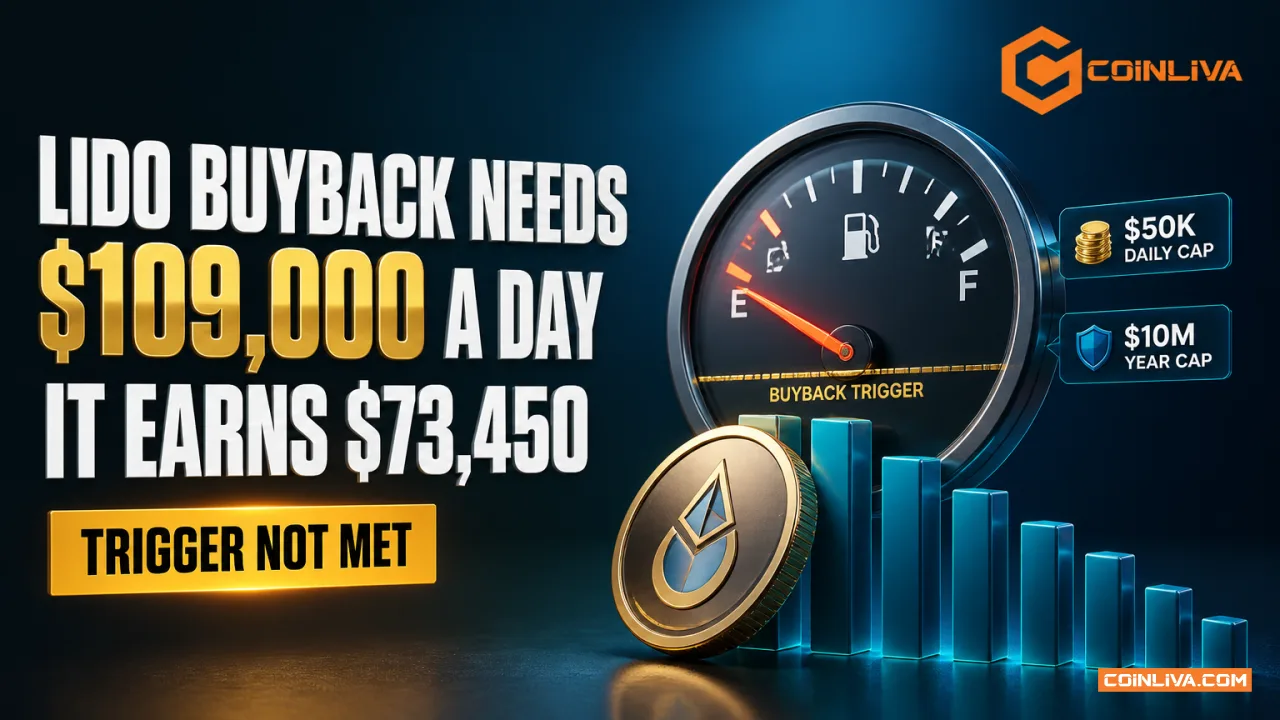
Lido DAO put its token buyback on chain this week. Vote 204 opened on August 5 and closes Saturday at 13:00 UTC, and if it passes, the mechanism called NEST starts routing surplus staking revenue into open-market purchases of LDO. The Lido buyback has one gate in front of it. Revenue has to clear a $40 million annual baseline before a single dollar moves, and that works out to roughly $109,589 a day.
DefiLlama currently shows Lido earning $73,450 over the past 24 hours.
So the program ships with its trigger below the water line. Nothing about the vote changes that. It simply installs the plumbing and waits for the number to come back.
Every revenue window DefiLlama publishes sits under the baseline
The 24 hour figure is the sharpest one, but it is not an outlier. Over the last 30 days Lido booked about $2.15 million in revenue against $34.59 million in fees, which averages near $71,700 a day. Annualize that and you land around $26 million. DefiLlama's own trailing annualized revenue field reads $38.72 million. Three different windows, three answers, all of them beneath $40 million. The Lido buyback contract reads a daily counter, so the shortfall is not something a strong quarter papers over retroactively.
The protocol is not small. Lido holds roughly $18 billion in total value locked and takes about half of the entire liquid staking category, according to DefiLlama's category page. The gap is priced, not structural: staking rewards are denominated in ether, and ether trades near $1,901. Lido's own governance thread makes this explicit. The contracts carry an ETH price floor parameter that the workgroup set to zero, on the reasoning that the revenue baseline already starts biting on its own somewhere around $2,700 per ETH. Ether would need to rise about 42% before the Lido buyback has anything to spend.
Reaching the ceiling is a longer walk. NEST takes 50% of the surplus above the baseline and stops at $10 million on a rolling twelve month basis, so filling that cap requires $60 million of annual staking revenue. Against the current run rate that is more than double. Governance votes with real thresholds tend to look different once the arithmetic is on the table, the way Zcash's NU7 vote turned on one wallet crossing a line.
The Curve pool got cut out of the launch
Most of the short coverage this week described NEST as a buy-and-pair design: half the money buys LDO through CoW Swap, the other half becomes wstETH and both sides go into a Curve pool the DAO owns. That was the version approved at Snapshot in May, where 52.4 million LDO voted in favor against 3.0 million opposed. The Lido buyback on the ballot looks different.
In a July 15 post to the Lido governance forum, the workgroup proposed launching in treasury-only mode, sending every purchased token straight to the Aragon Agent with no liquidity position at all. Two reasons were given. There is no audit report covering the exact version of the Curve TwoCrypto-NG code deployed on chain, and further modelling suggested pool-deepening liquidity only materializes during a sustained joint uptrend in both assets. LP mode stays available later through a single parameter update, without redeploying anything. The August 5 post confirming vote 204 is live states the treasury-only framing directly.
$50,000 a day against a $38 million tape
Assume the baseline clears tomorrow. The Lido buyback still runs into a daily execution cap of $50,000, with a minimum spend per call of $1,000. LDO turned over $38.4 million in 24 hours on CoinMarketCap's count and $49.9 million on CoinGecko's, which puts the maximum daily bid somewhere between a tenth and a seventh of one percent of the tape. The full $10 million annual cap, if it were ever reached, amounts to about 4% of a $245 million market cap spread across a year.
Delegates raised this in March. One pointed out that Lido's share of staked ether had slid from 33% to 22% while LDO went from $4 to about $0.20, all of it after more than $100 million of treasury spending. Another argued the token stays a governance wrapper regardless of what the treasury buys, which is the sharpest thing anyone has said about the Lido buyback so far. Compare that to Pump.fun burning $370 million of supply outright, or to Hyperliquid pushing $51 million back to holders in a single month, and the scale difference is the whole argument.
LDO trades at $0.2932, down 18.2% over seven days per CoinGecko, which is roughly where it sat before the vote opened. The Ethereum staking queue and the yield it competes with matter more to that $40 million line than any governance decision does. Vote 204 closes Saturday afternoon UTC, and the delegate turnout will be worth reading against the 75% margin Aave's DAO produced on its own strategy vote. After that the contracts sit and watch a revenue counter that answers mostly to the ether price. Switching LP mode on later takes another vote and one parameter change, so that piece of the design is still open.