
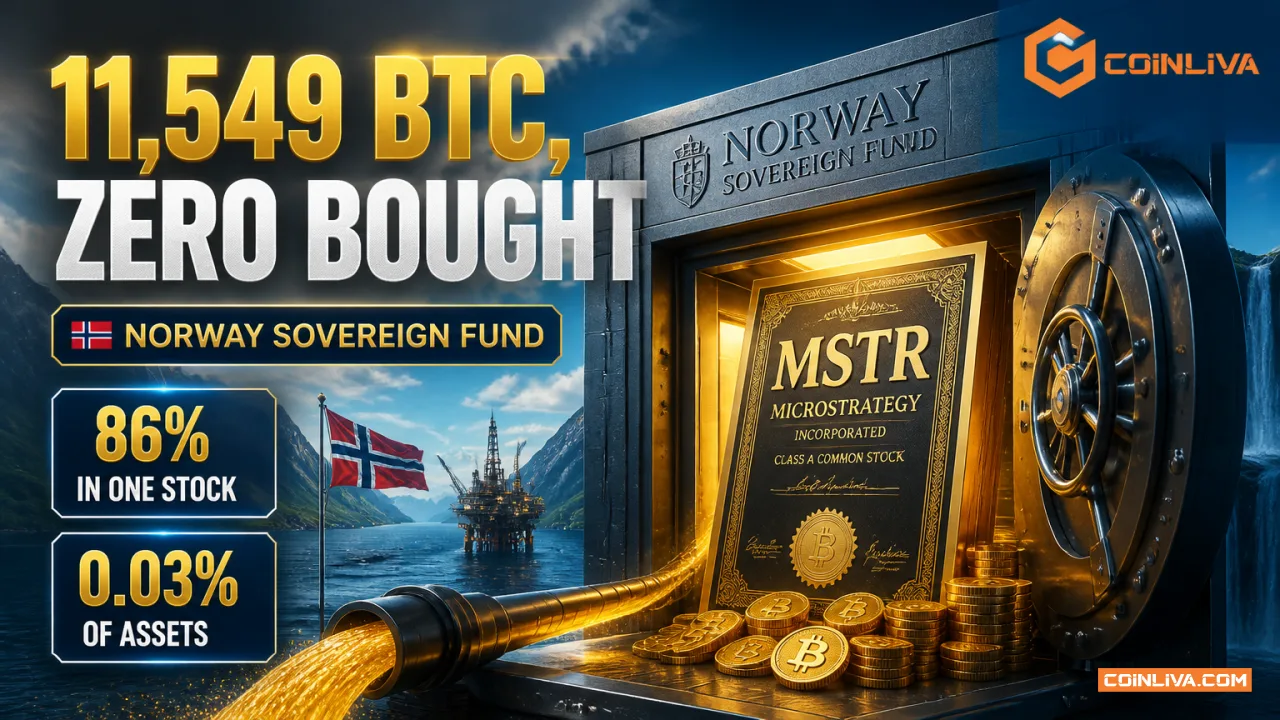
Norway's sovereign wealth fund holds more bitcoin exposure than at any point in its history, and it got there without buying a single coin. As of June 30 the fund carried 11,549 BTC worth of exposure, about $725 million, all of it secondhand.
The figure comes from K33 Research, where head of research Vetle Lunde pulled it out of the first-half filings of Norges Bank Investment Management. NBIM runs the roughly $1.9 trillion fund, the largest of its kind anywhere, and it owns no spot bitcoin at all. What it owns is shares in companies that hold crypto on their own books, which is a very different exposure.
Eighty-six percent of it lives in one company
Strategy does almost all the lifting. Michael Saylor's firm accounts for 9,914 of those 11,549 BTC, close to 86% of the total. Norway's stake in Strategy runs about 1.17% of the company, a position worth roughly $357 million, and that one holding is where the bitcoin exposure actually concentrates. The rest is a set of rounding lines.
| Holding | BTC equivalent | Share of exposure |
|---|---|---|
| Strategy (MSTR) | 9,914 | 85.8% |
| Metaplanet | 671 | 5.8% |
| MARA | 421 | 3.6% |
| Coinbase | 183 | 1.6% |
| Block | 120 | 1.0% |
| Tesla | 97 | 0.8% |
Metaplanet, the second name on the list, is the same Tokyo treasury company whose reported coin count recently drifted from what its wallets showed on-chain. Norway holds it anyway, along with MARA, Coinbase, Block and a thin slice of Tesla. None of these were bitcoin decisions. They are index weights that happen to contain crypto.
The record moved because the stocks did
The bitcoin exposure climbed 21.2% in the first six months and 60.5% over the year. NBIM did not add to any of it on purpose. It indexes almost every listed company on the planet, so when Strategy's shares rallied and the firm kept stacking coins, Norway's paper bitcoin rose right along with them. Lunde's framing is blunt. This is a consequence of diversification, not an allocation anyone chose.
Scale keeps the record honest. The entire 11,549 BTC amounts to about 0.03% of the fund's assets, down from 0.04% at the end of 2025, so as a share of the portfolio it actually shrank while the coin count grew. Split across Norway's population it comes to roughly $125 a person, near 205,000 satoshis. And through Strategy alone the fund now rides a claim on more bitcoin than BlackRock's entire spot ETF holds, purely as a side effect of owning the market.
Abu Dhabi actually chose bitcoin
Abu Dhabi offers the clean contrast. Mubadala held 14.7 million shares of BlackRock's IBIT spot ETF at the end of the first quarter, a $565.6 million position it has topped up every quarter since late 2024. Fold in Al Warda Investments and UAE state money parked in IBIT passed $1 billion by the end of last year. That is a fund that decided it wanted bitcoin and went and bought the ETF outright, the same deliberate move several US banks made when they surfaced in Q2 filings.
Norway ran the opposite way, backing into a larger headline through positions it never picked. The same accident shows up on the ethereum side, where NBIM holds about 67,340 ETH worth of exposure through a 1.16% stake in Bitmine. For now the number keeps growing on its own, and it will keep tracking Strategy's share price rather than anything Oslo sets out to do.