The vote failed before one delegate stepped in
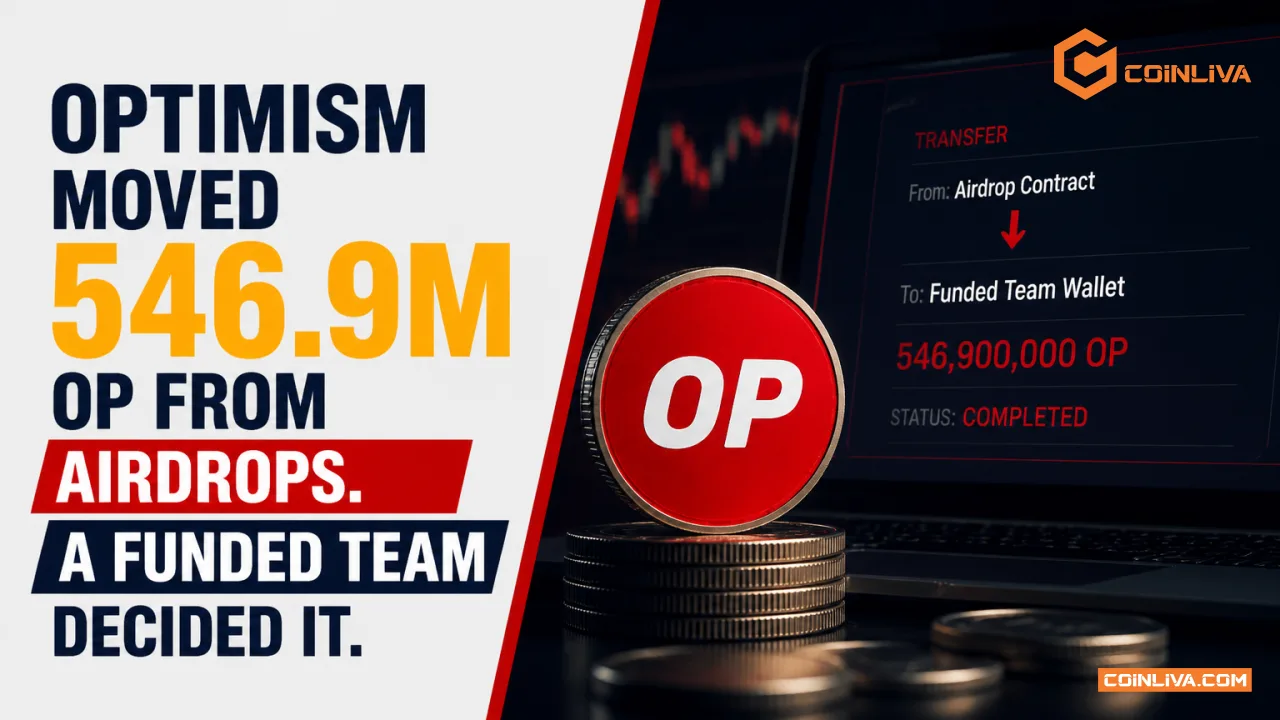
Optimism just pulled 546.9 million OP out of its future airdrop budget. At current prices that is roughly $49.7 million, and about 12.7% of the token's entire supply. The tokens now sit in a strategic fund the Optimism Foundation controls, earmarked for grants and partnerships rather than for users.
Count every delegate and the proposal cleared with 61.84% support: 17.974 million OP in favor against 10.931 million opposed. Now take one voter out. A single development team, Test in Prod, cast 8.486 million OP for the measure with 16 minutes and 52 seconds left before the poll closed. Without that bloc, approval drops to 46.47%. The proposal fails.
So the whole reallocation turned on one late vote from a delegate that is anything but neutral.
The margin, with and without the deciding bloc
| Tally | OP in favor | OP against | Approval |
|---|---|---|---|
| As recorded | 17.974M | 10.931M | 61.84% |
| Test in Prod removed | 9.488M | 10.931M | 46.47% |
Test in Prod draws its pay from the network it funds
Test in Prod is a core Optimism development team. By its own 2025 Security Council nomination, it is "fully funded by the Collective," and it holds a seat on that same Security Council. The Optimism treasury pays it. Its deciding vote then pushed treasury tokens toward a pot the Foundation administers, and the Foundation shapes where that team's own money comes from.
None of this is buried. The nomination is public, the vote lives on chain, and the timestamp shows the exact second the bloc landed. What it adds up to is a delegate with a paycheck on one side of the ledger casting the swing vote on the other. Optimism runs on a two-house model, a Token House of delegates and a Citizens' House, meant to stop any single actor from deciding an outcome alone. Optimism governance has cleared large proposals before on broad turnout, the way an Aave DAO proposal passed earlier this year with 75% support. This one cleared on a single account. The ENS DAO hit a nearby problem this month when it moved a $65 million endowment with spending caps that were never written into code.
Optimism is retiring airdrops, not pausing them
The Foundation's argument is that broad giveaways have done their job. Airdrops, it says, fit an earlier phase built on pulling in retail users, while the current push is institutional. Optimism now courts banks and enterprises instead of retail wallets. Five airdrop rounds have already sent 269.1 million OP to wallets since 2022, and the Foundation plans no further rounds. That framing turns a cut into a graduation.
Critics read it another way. L2BEAT, a research group that tracks layer-2 networks, objected to the "open-ended authority" the fund hands the Foundation, the unclear link to token holder value, and the absence of any review of how earlier partnership money got spent. Optimism has handed OP to hundreds of thousands of addresses over four years, and that open hand was much of the reason developers trusted the network early on. There is no public scorecard for the last round of grants, and the Foundation now has a far bigger sum to spend at its own discretion. For a network whose pitch has always been credible neutrality and a shared standard across chains, moving the community's slice into a treasury the core team runs is a strange look. It follows a wider drift this month of token supply tilting toward insiders instead of users, as when LayerZero's latest ZRO unlock sent 94% to insiders. The next thing to watch is simple. Where the 546.9 million OP actually lands, and whether anyone outside the Foundation gets to check the receipts.