
Borrowing dressed up as a raise
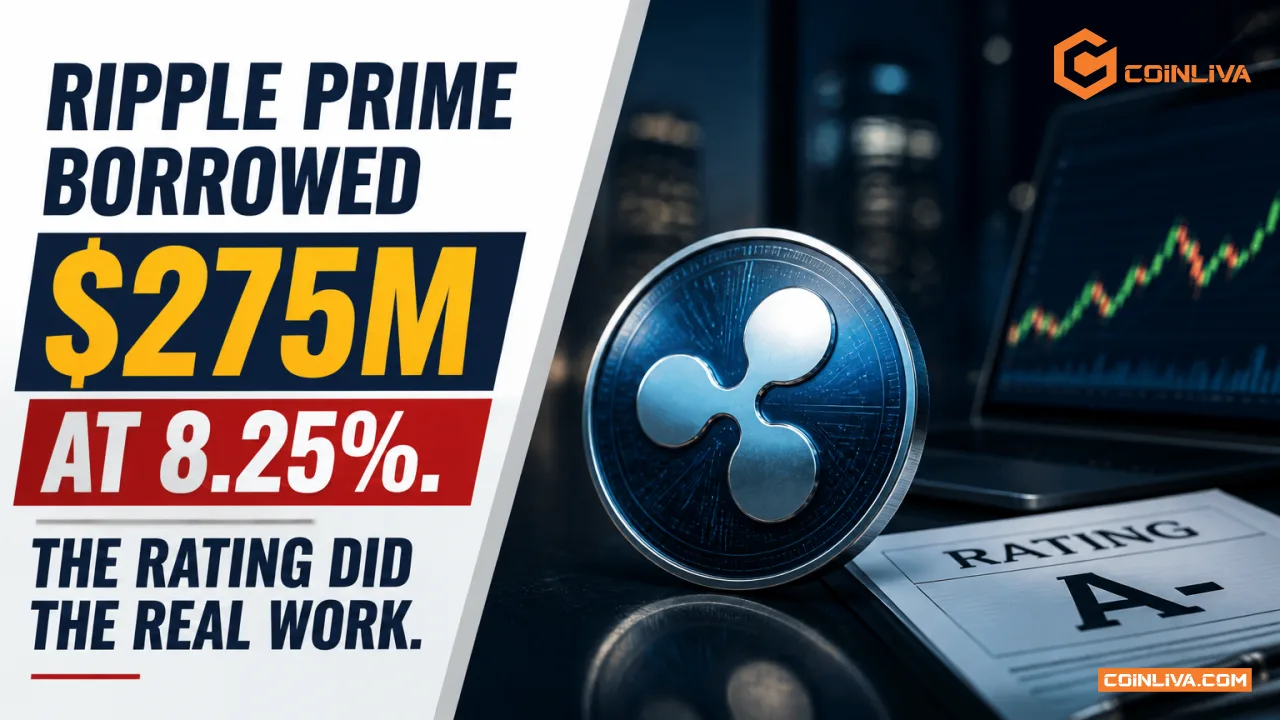
Ripple Prime pulled in $275 million this week, and nearly every headline called it a raise. The word doing the quiet work there is "raise." This was not an equity round. It was senior unsecured notes, an 8.25% coupon, maturity in 2031, placed privately with Piper Sandler running the book. Demand ran hot enough that the offering was upsized. The unit borrowed, at a rate a mature tech company would think twice about, rather than sell a slice of itself.
That choice is worth sitting with. Ripple has already put roughly $500 million of its own capital into the subsidiary, with another $500 million pledged through the rest of 2026. The parent was valued at $40 billion in a May equity round backed by Neuberger Berman managed funds. A company with that balance sheet could have funded a $275 million expansion out of pocket. It went to the bond market instead, and it paid up to be there.
KBRA stamped it BBB, and that is the actual story
The rating is the reason the debt exists in this shape. KBRA graded the notes BBB, investment grade, and Ripple Prime now stands as the only crypto-affiliated prime broker carrying one. That label is not decoration. Pension funds, insurers and banks run under credit rules that bar or penalize counterparties rated below investment grade. A BBB stamp lets those institutions clear and finance through Ripple Prime without carving out an exception in their own risk manuals. Noel Kimmel, who runs the unit, framed it directly: the firm is being underwritten like a mainstream financial company, not priced as a speculative crypto bet.
Hold the two numbers next to each other, though. BBB is the lowest rung of investment grade, and an 8.25% coupon running to 2031 is roughly what the market charges for crypto counterparty risk even after the agency signs off. The rating opens the door. The price of walking through it stayed high. Ripple has spent the year wiring credit into the market from other directions too, from raising Gemini's credit line to $250 million to funding its own clearing stack. What is new is a third party putting an investment-grade number on it.
Ripple Prime's 2026 funding stack
| Source | Amount | Type | Terms |
|---|---|---|---|
| Ripple parent capital | About $1B | Equity injection | $500M in, $500M pledged |
| Neuberger Berman funds | $200M | Credit facility | May 2026 |
| Senior unsecured notes | $275M | Debt | 8.25%, due 2031 |
Goldman is the wrong benchmark
There is real weight under the headline. Ripple bought Hidden Road for $1.25 billion in April 2025, closed the deal in October, and rebranded it Ripple Prime. Before the acquisition Hidden Road was already clearing around $3 trillion a year for more than 300 institutional clients. Revenue at the unit has tripled year over year since. This is not a startup borrowing against a pitch deck.
People keep reaching for Goldman as the yardstick, and that misses the point. Goldman clears billion-dollar equity books on a balance sheet Ripple has not built, and its own crypto desk kept its bitcoin while clearing altcoin ETFs. The firms that actually sit across the table are crypto-native clearers, Coinbase Prime and FalconX, which has been extending large credit lines of its own. Against that field, the BBB rating is a genuine edge, because none of the others hold one.
The number to watch is the second $500 million. If the parent covers it from treasury, this week's notes read as a one-time test of how much institutional money will lend to a crypto prime broker. If Ripple Prime comes back to the debt market instead, the 8.25% turns into a benchmark, and the next coupon will tell you whether investors decided the rating was earned or generous.