
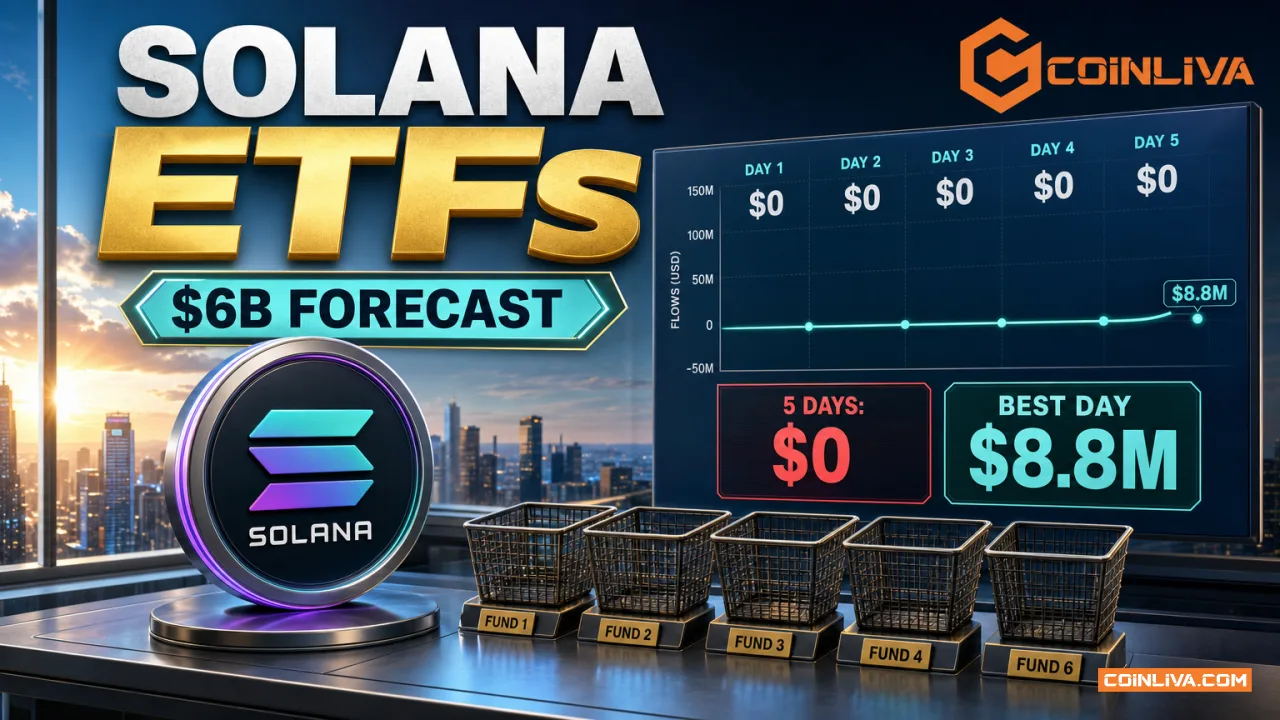
The pitch was a big number. Before the first US Solana ETF opened, JPMorgan and Bitget's Ryan Lee both pegged first-year inflows at $3 billion to $6 billion, and Cointelegraph carried the $6 billion figure as SOL joined the "big league." The funds have traded for months since. The tape reads nothing like the forecast.
Five sessions, not a dollar
Between July 29 and August 4, all six US Solana ETFs logged five straight sessions of exactly zero net creations, according to flow data compiled by CryptoSlate. Not thin inflows. Zero. The streak followed an $18.1 million outflow from Bitwise's BSOL on July 28.
Then came the rebound headline. On August 10 the group pulled in $8.83 million, its strongest single day since May, with almost all of it landing in BSOL. The Coin Republic wrote it up as the biggest Solana ETF inflow in three months. It was. That is the problem. A number that small being the high point tells you what the other days looked like.
Zero net creation is a narrow measure worth understanding. It tracks the primary market, shares minted and redeemed with the issuer, and says nothing about secondary trading on the exchange. So these were not frozen funds. Hands still changed on the tape. What stopped was fresh money asking an issuer to create new shares, and that is the flow that lifts assets under management and, in theory, bids for spot SOL. It is also the exact channel the $6 billion forecast was built on.
Most of the billion was never investor money
The cumulative figure sounds respectable until you open it. CryptoSlate put net Solana ETF inflows at $1.122 billion through August 4. Seed capital, the money issuers park to stand a fund up, makes up $449.3 million of that, roughly 40 percent. Grayscale, which recently withdrew three other altcoin ETF filings, brought another $102.7 million in conversion capital from its old product. Take those out and genuine investor creations come to about $570 million over the entire life of the funds.
| Solana ETF flows | Amount |
|---|---|
| July 29 to August 4 (five sessions) | $0 |
| August 10, best day since May | $8.83 million |
| Cumulative net inflows to August 4 | $1.122 billion |
| Seed capital, issuer funded | $449.3 million |
| Grayscale GSOL conversion capital | $102.7 million |
| Genuine investor creations | about $570 million |
The six funds are BSOL from Bitwise, VSOL from VanEck, FSOL from Fidelity, TSOL from 21Shares, SOEZ from WisdomTree and GSOL from Grayscale. One large fund is carrying five small ones. TSOL held around $3 million in early August. Bitwise sits on the rest.
The price sat still while the flows dried up
SOL traded near $76 through the whole stretch. Total Solana ETF assets stood near $906 million on August 10, under the $1.15 billion that has flowed in cumulatively, because the coins bought at higher prices are worth less now. When Coinliva covered Solana funds bleeding alongside bitcoin and ether in March, the read was a soft patch. Five months on, the soft patch has not lifted.
Compare it with a wrapper that actually drew money. Earlier this year HYPE's ETFs pulled in $100 million in a single month. Solana's staking pitch, a 5 percent yield stacked on spot exposure, was meant to do that work, and JPMorgan's high end assumed it would. So far the yield has not been the magnet the projection needed it to be.
None of this sinks the underlying network. Usage keeps turning up in other places. Solana's real-world-asset holder count has climbed this year, and on-chain activity has never been the weak spot. The ETF wrapper was sold as an institutional floodgate, and so far the water has been a trickle. The gap between $6 billion forecast and $570 million delivered is the number worth tracking, not the occasional green day that gets written up as a turn.