
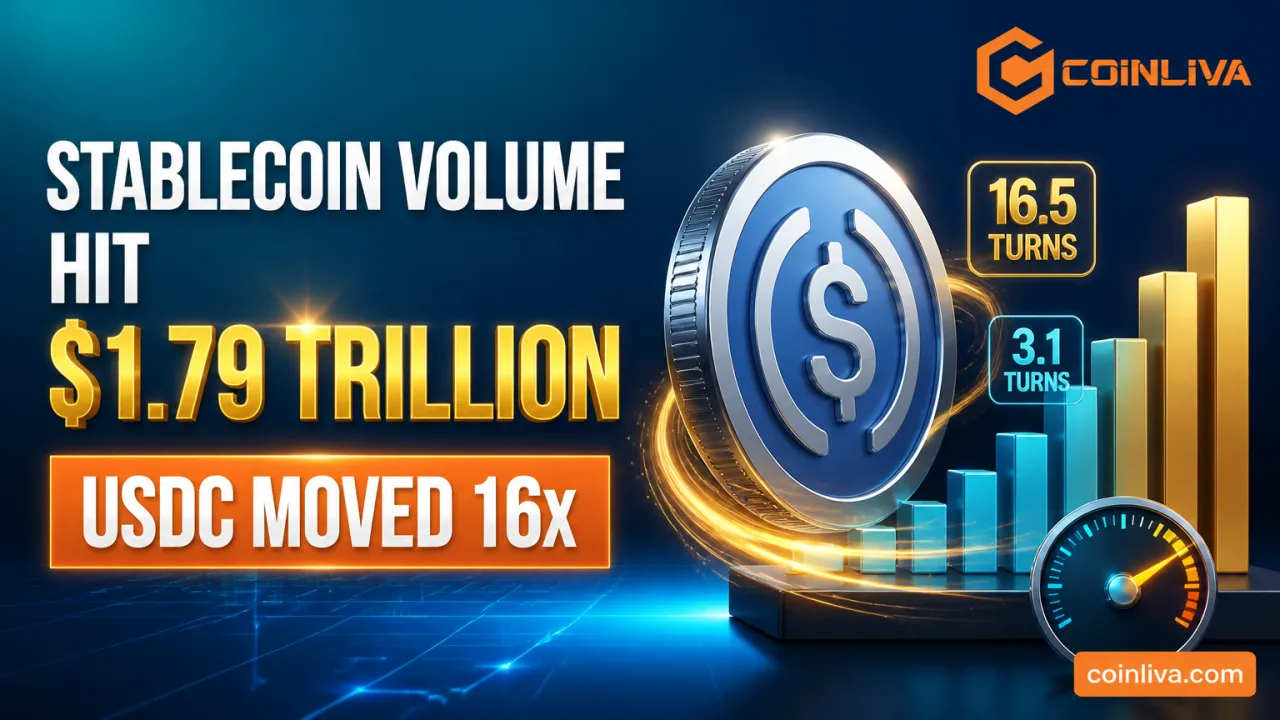
June set a record for stablecoin volume. Visa's Allium-powered dashboard logged $1.79 trillion in adjusted transfers, up 63% from May and 125% from June 2025. The same month, $7.7 billion left stablecoin supply, the first month-end contraction in five months and the steepest since the Terra collapse in May 2022.
Both numbers are accurate. Most of the coverage picked one.
USDC handled two thirds of the transfers on a quarter of the float
Break the $1.79 trillion down by issuer and the market stops looking like one asset class. USDC accounted for roughly $1.21 trillion of June's adjusted stablecoin volume. Tether's USDT accounted for about $576 billion. Set each against the supply that produced it.
| Token | June adjusted volume | Market cap, July 30 | Turns per month |
|---|---|---|---|
| USDC | $1.21 trillion | $73.4 billion | about 16.5 |
| USDT | $576 billion | $184.1 billion | about 3.1 |
| All stablecoins | $1.79 trillion | $312.1 billion | about 5.7 |
Sixteen turns. Every dollar of USDC in circulation moved, on average, more than sixteen times in thirty days, while every dollar of USDT moved roughly three. Circle's token carries under 40% of Tether's float and still pushed twice the transfer volume through it. The two coins are doing different jobs. USDC behaves like a settlement rail that institutions clear through and empty out; USDT behaves like a balance people park on exchanges and in emerging-market wallets and leave alone for weeks.
Circle has been building toward that first role for a while, including a $222 million raise to build its own chain. Turnover shows whether the strategy is landing. Market cap hides it.
The float is flat rather than draining
DefiLlama read total stablecoin market cap at $312.1 billion on Thursday, up 0.27% over seven days and down 1.07% over thirty. USDT sat at $184.1 billion, off 1.39% on the month. USDC sat at $73.4 billion, off 2.11%. CoinDesk's July 12 report put the market about $10 billion below its May peak and quoted Wincent senior director Paul Howard calling it "a relatively small pullback in what we believe is a long-term growth market."
A 2.39% monthly decline in a $312 billion market is redemptions outpacing mints for a few weeks. Terra was a depeg event. This is a float that stopped growing while the rails underneath it got busier.
One caveat belongs next to every stablecoin volume record. Visa's own economics work identified roughly $390 billion of real-world payment activity in 2025, close to 1% of total stablecoin volume that year. The rest is trading, market making, treasury operations and bridging. Merchant settlement is growing off a small base, with DoorDash paying through Stripe's rails, and the consumer layer stays fragile enough that a card issuer can shut off in a day.
RLUSD turns faster than the market and its volume still fell 25%
RLUSD makes the same point from the other side. RWA.xyz data cited by CoinDesk on July 24 put monthly transfer volume at $10.95 billion, down from $14.6 billion a month earlier. Supply reads $1.651 billion on DefiLlama today, 889 million on Ethereum and 762 million on the XRP Ledger. Even after a 25% fall, that is roughly seven turns a month, above the market average and more than double USDT's rate.
The methodologies differ, so the figures should not share a column. Visa's dashboard filters self-transfers and automated noise out of the count; RWA.xyz reports raw transfers. The direction travels across both datasets. RLUSD holder count rose 6% over the month and active addresses rose 70% while volume fell a quarter, which describes more wallets moving smaller amounts.
July's dashboard print lands in early August. Two readings matter more than the market cap headline: whether USDC turnover holds above fifteen after another flat month, and whether the $7.7 billion that walked out in June comes back.