
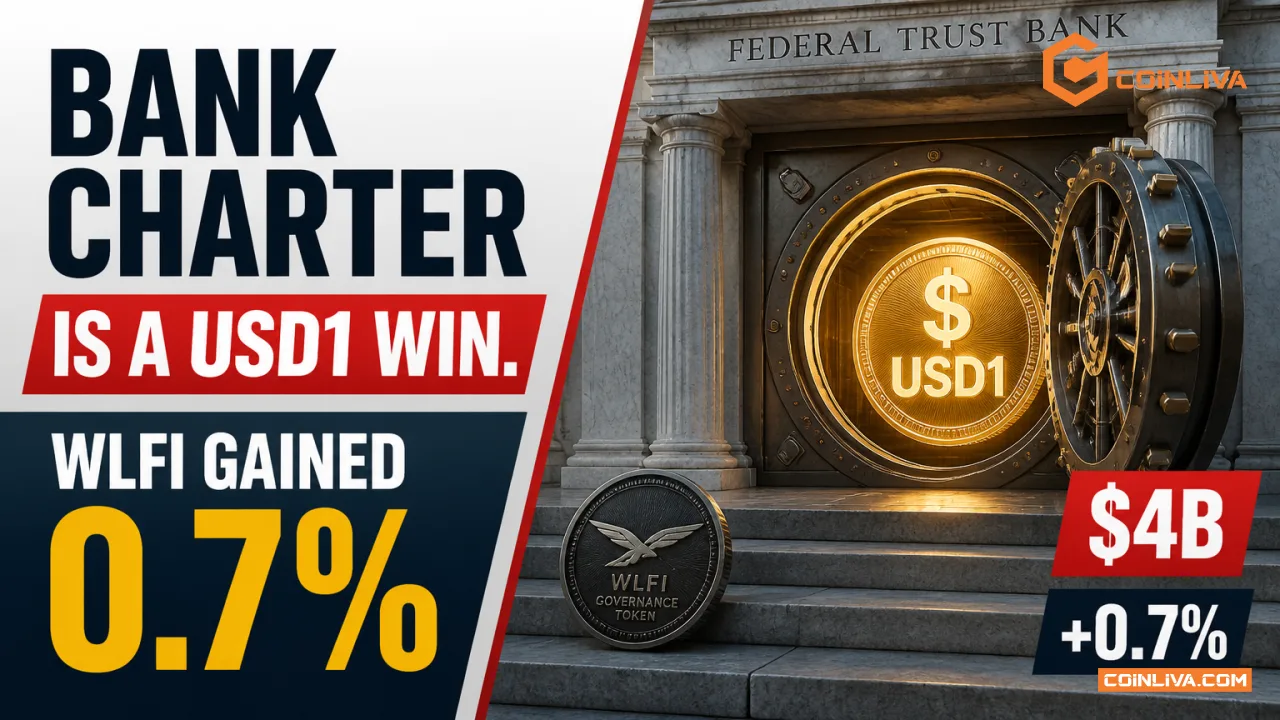
The Office of the Comptroller of the Currency handed World Liberty a national trust bank charter on August 14. Most outlets read it as a Trump-crypto milestone. The market read it as something narrower. WLFI, the governance token that carries the World Liberty name, gained about 0.7 percent on the day and is still down 61 percent for the year.
Two things share a brand here, and only one of them got the charter. The bank is built to serve USD1, the group's dollar stablecoin, now the fourth-largest at roughly $4.0 billion. WLFI is the tradeable token, and the preliminary approval gives WLFI holders no ownership of the bank at all. A token named after the winning company barely moved on the day its company won.
The charter is plumbing for a stablecoin
The approval went to World Liberty Trust Company, a national trust structure rather than a full commercial bank. It permits custody, settlement, reserve management, and the issuance and redemption of USD1 under federal supervision. It generally does not allow deposit-taking or lending. The conditions attached here are routine supervision items: at least $20 million in capital, a qualified internal audit manager, and advance notice to regulators before major changes to the business plan.
All of that is machinery for running a regulated stablecoin. None of it reaches WLFI holders in practice. The charter changes how USD1 is custodied and settled; it does not send a dividend, a buyback, or a claim on bank revenue to WLFI, the token that shares its branding. That gap is the whole story.
USD1 climbs while WLFI sinks
USD1 has grown around 21 percent since January, from about $3.3 billion to $4.0 billion. It ranks behind Tether's USDT and Circle's USDC, and sits just ahead of Ethena's USDe. A federal charter is exactly the credibility marker a younger issuer wants when it is trying to pull institutional custody and settlement business away from incumbents. For USD1, this is a real step.
| Measure | USD1 stablecoin | WLFI token |
|---|---|---|
| Market value | About $4.0 billion | About $1.76 billion |
| Move around the approval | Steady near $0.999 | Up 0.7 percent |
| Year so far | Up roughly 21 percent | Down 61 percent |
| Benefit from the charter | Custody, reserves, settlement | None |
WLFI has gone the other way for months. We covered the token when it set an all-time low near $0.077 in April; today it trades under that mark, around $0.055, for a market value close to $1.76 billion. Insider selling and unlock votes have shaped its price this year far more than any product news. The bank charter is product news for USD1, and WLFI behaved accordingly.
Circle already cleared the same door
World Liberty is not first in line. Circle secured its own national trust approval earlier in 2026, and other issuers have been circling the same OCC door as stablecoin rules firm up. The appeal is simple: a federal charter lets an issuer custody its own reserves and settle under one supervisor instead of stitching together state licenses. That matters more as the market keeps expanding and Tether's share of it slowly shrinks.
The reserve question still hangs over the whole category. Tether, the largest issuer by a wide margin, is still answering questions about its reserve buffer, and USD1 has published far less about what backs it. A trust charter brings USD1 under an examiner who can ask those questions directly, which cuts both ways for a Trump-linked issuer.
For USD1, the approval is a step toward the institutional custody and settlement business World Liberty has described, though it remains preliminary and hinges on those conditions being met. For WLFI holders, it is a headline about a company they are named after but hold no stake in the bank of. Full approval, and whatever reserve disclosures arrive with it, is the next marker worth watching.