
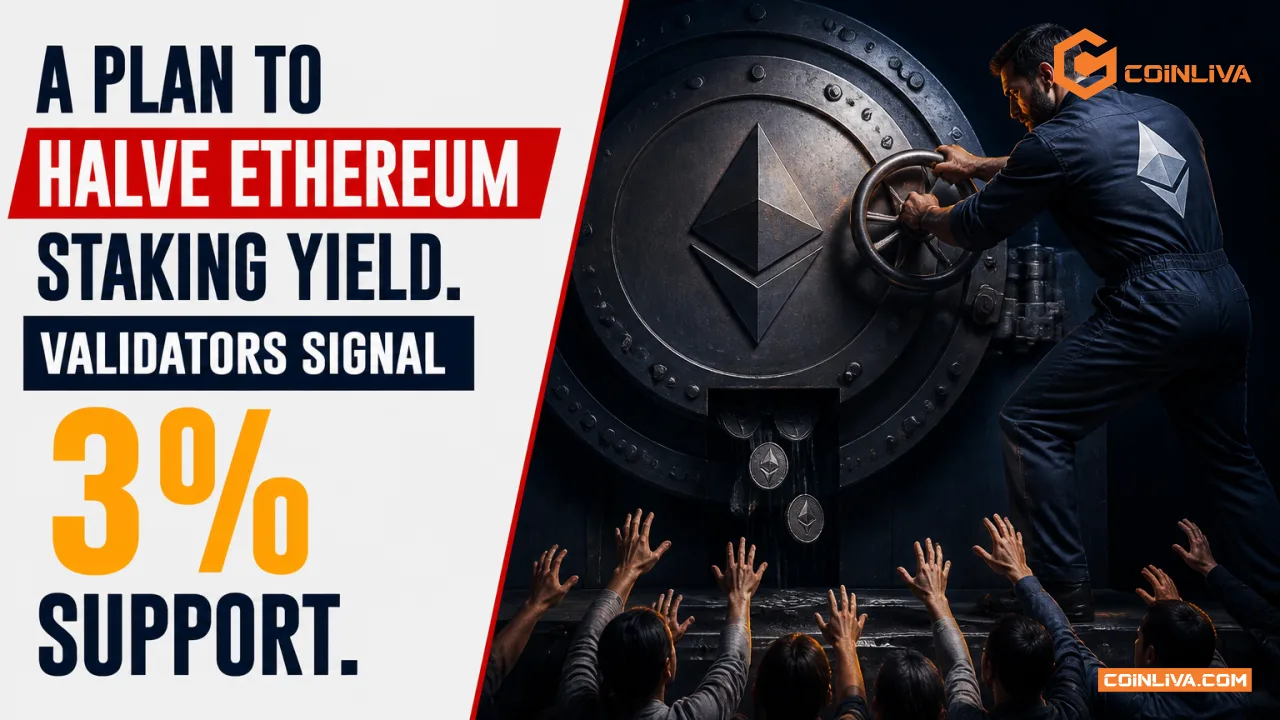
Ethereum's staking share has never been higher, and a proposal on the table would answer that record by cutting the staking yield that keeps it going. About 34 percent of all circulating ETH is now locked in the consensus layer, roughly 41.5 million coins, an all-time high. The plan, EIP-8363, would gradually burn a rising slice of the staking yield those validators earn until net issuance hits zero. It has become the loudest governance fight Ethereum has had in months. The people it targets have already told the network what they think of it.
Validator signaling sits near 3 percent
Before the researchers, the DeFi founders, and the forum moderators started arguing, the validators voted with the only tool they have. Signaling tracked in mid-August showed support for EIP-8363 at roughly 3 percent, with the other 97 percent opposed, a figure reported independently by more than one outlet. That is not a poll of Twitter. It is the operators who run the chain saying they do not want a change to how they are paid.
The pattern should feel familiar to anyone who watched the BIP 110 fight on Bitcoin. A proposal draws essays, threads, and days of debate, and underneath all of it the measurement that actually decides the outcome barely moves. A change to Ethereum's monetary policy needs the people securing the network to go along with it. Right now they are not close.
What the taper actually does
Ethereum pays validators through new issuance. The more ETH staked, the thinner that reward spreads, which is why the current staking yield has drifted down to around 2.65 percent from north of 5 percent three years ago. EIP-8363, sometimes called the tapered issuance burn, speeds that decline on purpose. As the staked share climbs, an increasing portion of newly issued rewards gets burned rather than paid out. The burn reaches 100 percent once about half of all ETH is staked, near 60 million coins, at which point net new issuance stops.
At today's staking level the change would cut the staking yield to roughly 1.2 percent over an 18-month transition, close to half of what stakers earn now. The authors include Ethereum Foundation researcher Justin Drake and Ethereum Community Conference co-founder Jerome de Tychey, alongside several other researchers.
| Metric | Now | Under EIP-8363 |
|---|---|---|
| ETH staked | About 34% of supply | Burn hits 100% at ~50% |
| Consensus yield | Around 2.65% | Roughly 1.2% at current levels |
| Net issuance at saturation | Positive | Zero near 60M ETH staked |
| Transition | - | About 18 months |
Why the researchers want the burn
The argument for the change starts from a claim that Ethereum overpays for its own security. With the entry queue still deep, the proposal's backers project more than 55 percent of supply could be staked by 2028 if nothing changes, which they read as the network buying protection it does not need. The staked share has climbed from about 29 percent at the start of 2026 to the current record, and the entry queue has stayed deep enough to keep pulling it higher. They also expect staking derivatives, the liquid tokens that stand in for locked ETH, to keep displacing plain unstaked ether over time, making high issuance harder to justify. Cap the reward, the reasoning goes, and you cap an incentive that has no natural ceiling. It is a monetary-policy position as much as a technical one, and it is worth understanding what staking pays for in the first place before deciding whether the network is spending too much on it.
Where the opposition lands
Aave founder Stani Kulechov ran the numbers publicly and put the hit to staking yield at a 48 percent cut, from 2.862 percent to 1.476 percent for a typical validator. His warning was sharper than the math. A zero-yield regime, he wrote, "accelerates the capture it means to deter," the worry being that thin margins push small solo operators out and hand more of the stake to the large, centralized services that can absorb the cost. Ether.fi chief executive Mike Silagadze answered within hours with a dozen paragraphs that drew about 90,000 views, complaining the proposal landed with roughly 48 hours of notice. Rotki's Lefteris Karapetsas and the Aave Chan Initiative's Marc Zeller lined up on the same side, raising process, tax, and DeFi-stability objections. Several of them made a simpler point too. Ethereum's issuance already runs below Bitcoin's, so a further cut reads less like prudence than like a fix hunting for a problem the network has not clearly shown it has.
Then the fight got uglier. Attorney Gabriel Shapiro alleged that a core developer had deleted about 50 critical comments from the EIP-8363 thread on the Ethereum Magicians forum. A moderator defended the removals as targeting duplicate or sockpuppet accounts posting what one developer called "AI slop." Kulechov called the tactics concerning and said they would only harden the opposition. For a proposal already sitting at 3 percent support, a moderation row was the last thing its backers needed.
The number half the coverage got wrong
Plenty of outlets are still filing this story as EIP-8361. That was the number the authors self-assigned when they first posted the draft. The EIP editors renumbered it to 8363, and the older label stuck around anyway, copied from one repost to the next. It is a small thing, but it tells you how the cycle moved: fast, loud, and a step behind the source. The substance is not small. Ethereum is deciding whether the money it prints to secure itself is a feature or a leak, and the answer sets the yield on tens of millions of staked coins. The lower that staking yield falls, the harder it competes with the risk-free rate stakers could get elsewhere, and the more the question stops being ideological and starts being a spreadsheet.
EIP-8363 is still a draft, not a scheduled change, and the debate over Ethereum's issuance has surfaced on developer calls without a decision. What happens next depends less on the essays than on whether the researchers can move validator signaling off 3 percent, or rewrite the proposal into something the operators securing the chain will actually run. Until one of those two things happens, the plan to reshape how proof-of-stake pays for security is a paper with a lot of readers and very few supporters where it counts.