
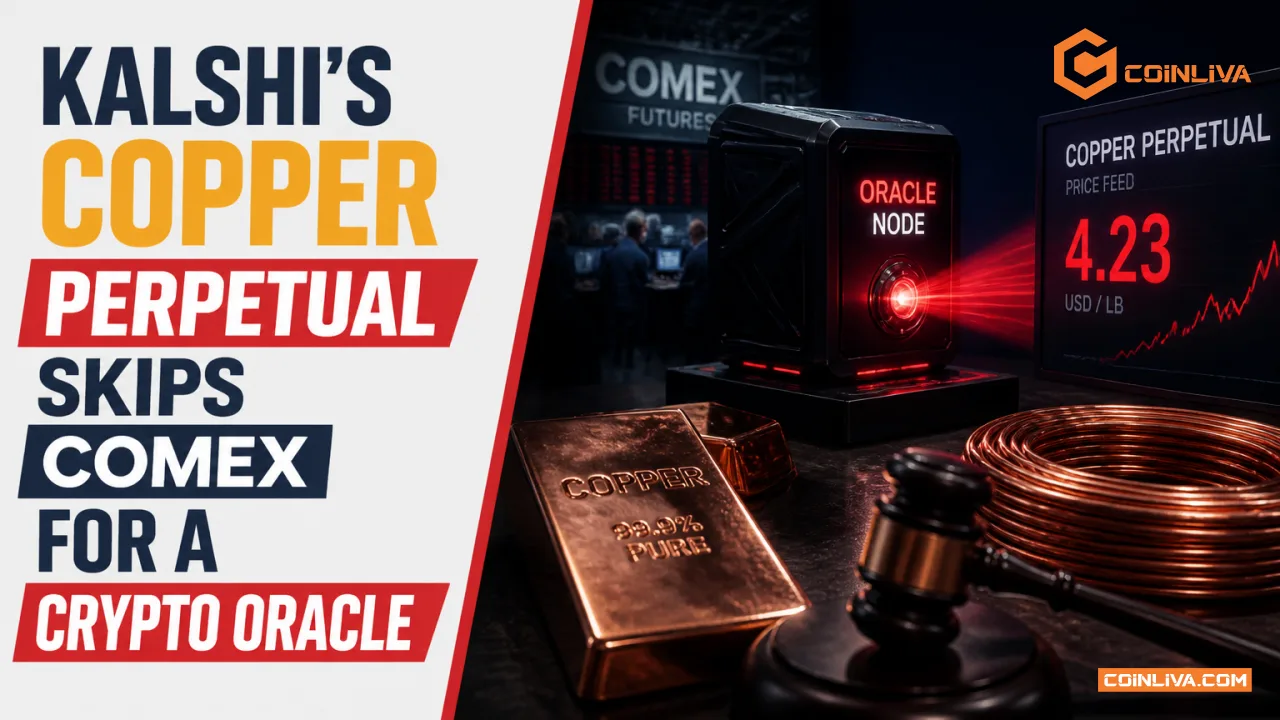
Kalshi filed the paperwork on August 18. Buried inside it is a copper perpetual, and the price it settles against does not come from any metals exchange. It comes from a blockchain oracle. The company that built its name on election and sports bets now wants to run a copper contract that borrows its plumbing from crypto.
The filing lists two products, both self-certified with the Commodity Futures Trading Commission. One is US500, tracking the MerQube US Large Cap Index of the 500 biggest American companies. The other is COPPERPERP, a copper perpetual quoted in dollars per pound. Neither has an expiry date, which is the whole point.
The copper perpetual runs on a funding rate, not a delivery month
Traditional copper futures on COMEX or the London Metal Exchange settle on a fixed calendar. A perpetual never settles at all. Instead, periodic payments pass between longs and shorts to keep the contract tethered to spot. That funding mechanism was invented on offshore crypto venues around 2016, and it is the same design that lets a trader hold a bitcoin perp open forever.
What Kalshi wants to price it against is the more telling detail. The copper perpetual references the Pyth Network XCU-USD feed, a decentralized oracle that pulls quotes from exchanges and market makers and publishes them on-chain. Copper priced by a crypto data network rather than by the COMEX order book is a real break from how the metal has traded for a century.
Kalshi has leaned on outside feeds before, settling contracts on FlightAware flight data in an earlier product. Hyperliquid, meanwhile, has already folded prediction markets into its perps. The direction of travel is the same: the crypto perpetual keeps escaping crypto.
| Feature | Kalshi COPPERPERP | COMEX copper future |
|---|---|---|
| Expiry | None, held open indefinitely | Fixed monthly contracts |
| Price source | Pyth Network XCU-USD oracle | COMEX order book |
| Settlement | Cash, no metal changes hands | Physical delivery available |
| Price alignment | Funding payments between traders | Convergence at expiry |
CME is suing over the door that lets this through
The filing rests on a legal footing that is already in court. In May 2026 the CFTC approved perpetual-style contracts for both Kalshi and Coinbase, starting with bitcoin. In June, CME Group sued the regulator, arguing it changed its approach without following the process the Commodity Exchange Act requires. The complaint is competitive at heart, since these products land on ground CME has long held.
It is not the first time the exchange has moved to block a rival, having earlier pushed to have Nasdaq's bitcoin options kept off the market over an index dispute. A ruling against the CFTC's approval path would not just stall the copper perpetual. It would slow every perp the agency has waved through.
Copper is the test, not the finish line
The choice of copper is not random. The metal feeds power grids, construction, electric vehicles, and the buildout of AI data centers, which makes it one of the more watched industrial prices going into the back half of the decade. Polymarket has signaled its own perpetual futures plans, so Kalshi is not moving alone. What the filing really tests is whether a CFTC-registered venue can wrap a crypto market structure around a physical commodity and get away with pricing it off-chain money never touches. The self-certification clock runs while CME's case moves in parallel, and the copper perpetual only goes live if the approval behind it survives.