
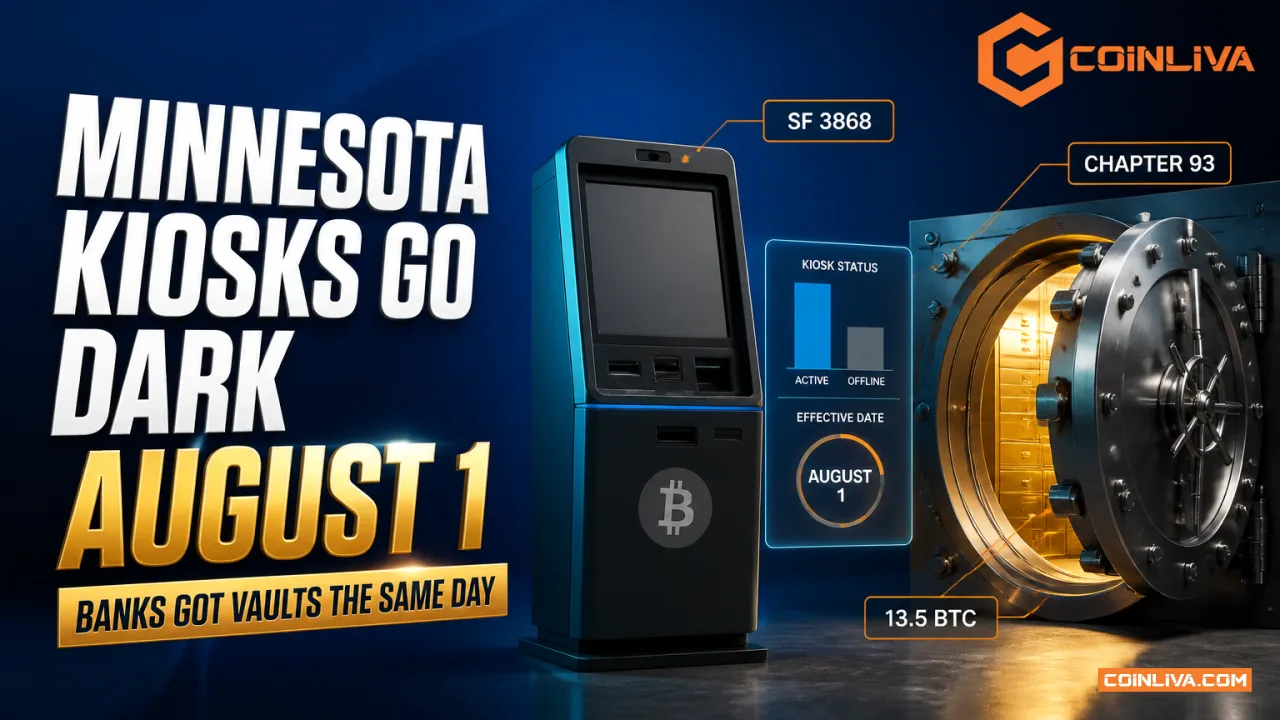
Minnesota crypto kiosks stopped being legal on Saturday. The statute that ended them runs to one sentence: beginning August 1, 2026, a person is prohibited from installing, operating, maintaining, or making available for use a virtual currency kiosk. That is the whole prohibition, new section 53B.751 in Senate File 3868. No transaction ceiling. No fee cap.
Almost nobody put the other half of the calendar next to it. The same August 1 date switched on Minnesota's bank custody law. Chapter 93 of the 2026 session laws lets state banks and credit unions hold customer virtual currency or the keys behind it, and applies to services commenced on or after that day.
One sentence ends the kiosk business
The bill also repeals the framework Minnesota built for these machines a year earlier, striking two subdivisions of section 53B.69 and five of 53B.75. That repeal carries its own effective date of January 17, 2027. Rules protecting customers at a machine nobody may lawfully operate stay on the books for another five and a half months.
Elder fraud drove the ban. Minnesota residents lost close to $1 million at the kiosks over several years, and Sara Payne, enforcement commissioner at the Commerce Department, cited how fast and irreversible the transactions are. The FBI counted more than $388 million lost to crypto ATM scams nationally in 2025, up 58%. Operators have bled too, as when Bitcoin Depot disclosed a $3.7 million theft.
Customer money has to be back by December 31
Balances do not vanish with the hardware. Any operator working only through Minnesota crypto kiosks must pay out customer funds by December 31, 2026, in U.S. dollars at market value or to a wallet the customer names, within 30 days of the request. Operators keeping another lawful channel are excused.
Banks got the opposite instruction that morning
Chapter 93 puts custody under sections 48.741 for banks and 52.25 for credit unions. Nonfiduciary capacity only. Written risk and cybersecurity policies, customer assets kept legally and operationally segregated from the institution's own, and 60 days of notice to the commissioner before launch. Credit unions may serve members and nobody else. Any institution live on day one filed by roughly June 2.
| Effective August 1, 2026 | Kiosk ban (SF 3868) | Bank custody (Chapter 93) |
|---|---|---|
| Direction | Prohibits an existing channel | Authorizes a new one |
| Statute | New section 53B.751 | Sections 48.741 and 52.25 |
| Key date | Customer payouts by Dec 31, 2026 | 60-day notice before launch |
| Who is covered | Any person operating a kiosk | State banks and credit unions |
St. Cloud Financial Credit Union moved early, opening its digital asset vault in March as the first in the state to custody for members. By May they held about 13.5 BTC through it. That is the swap so far: a cash channel with a fraud record closed, and a supervised one holding a few dozen coins.
Other places ran the sequence in the other order. Vietnam set fines to start in September with no licensed exchange in place, and Alabama gave DAOs a legal wrapper before enforcement came up. Doing both at once makes Minnesota crypto kiosk policy a test of whether supervised balance sheets cut the losses that ran past $11 billion nationally. The commissioner's filings this autumn will show how many banks follow Morgan Stanley into bank-issued bitcoin products.