
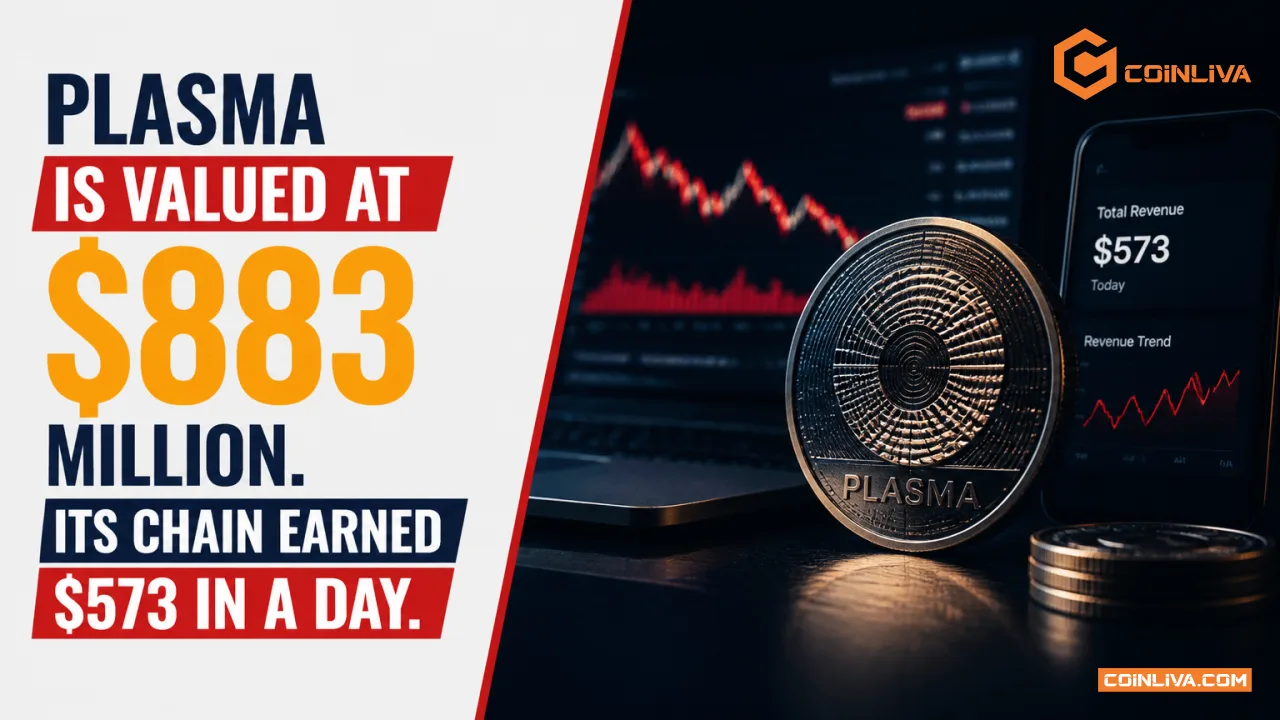
Plasma carries a fully diluted valuation near $883 million. Its base chain collected $573 in fees over the last 24 hours. That is the whole tension in one line, and the gap did not open overnight.
XPL, the token behind the Plasma stablecoin chain, trades around $0.088. It touched $1.68 last September. The fall from that high runs to roughly 95%. On August 25 another 88.89 million XPL unlocked, worth about $8.9 million, adding fresh supply to a token that was hardly short of it.
The pitch was TRON's throne
Plasma launched with one target. It would be the chain built for stablecoins, moving USDT for free, aimed straight at TRON, where most of the world's tether already settles. Tether backed it. It arrived with roughly $2 billion in liquidity and cracked the top ten by total value locked within weeks. Zero-fee USDT transfers were the whole headline.
Money showed up, and money is still there. Plasma holds about $873 million in stablecoins today, with bridged deposits above $2.4 billion. In a single day the chain cleared more than 525,000 transactions across 36,584 active addresses. By raw activity, this is not a ghost network.
Free transfers, empty till
The design that wins users is the same one that starves the token. Free transfers are the whole point, and free means the base chain earns almost nothing from the volume it carries. DefiLlama put chain fees at $573 over 24 hours, with chain revenue at the same figure. Apps running on top of Plasma did far better on paper, pulling in around $121,000 in fees that day. They kept little of it, converting that gross into roughly $10,000 of app revenue. And none of it flows to XPL anyway. The token owns the settlement layer, and the settlement layer is free by choice.
The deposits tell a matching story. Stablecoins worth $873 million sit on the chain, yet on-chain trading is thin, with daily DEX volume near $3.6 million. Capital parked for yield behaves differently from capital used to pay for things. The same split showed up when a billion dollars of USDe rotated out of a delta-neutral trade and into loans. Balances chase the best return. They do not always move.
| Plasma today | Figure |
|---|---|
| XPL price | $0.088 |
| Down from high ($1.68, Sep 2025) | 95% |
| Market cap | $240 million |
| Fully diluted valuation | $883 million |
| Stablecoins held on chain | $873 million |
| DEX volume, 24h | $3.6 million |
| Base chain fees, 24h | $573 |
Large balances are not payment volume
None of this makes Plasma a failure. The chain works, the transfers are real, and a network that keeps its stablecoin balances through a 95% token drawdown has something to point to. The problem is narrower. A valuation near $883 million, or even a market cap closer to $240 million, is pricing in fees the chain has chosen to give away. Markets misjudge what a token holds or earns in both directions, as they did when StablecoinX held $253 million in ENA against an $87 million valuation.
What would change the read is payment flow the token can eventually monetize, or a decision to stop giving the base layer away. Neither is here yet. The stablecoins that count are the ones that turn over, and June set a record when USDC moved 16 times its own supply on chains people actually settle on. Plasma's balances are large. Whether they start to churn like that, instead of sitting, is the figure to track as the next XPL unlocks arrive.