
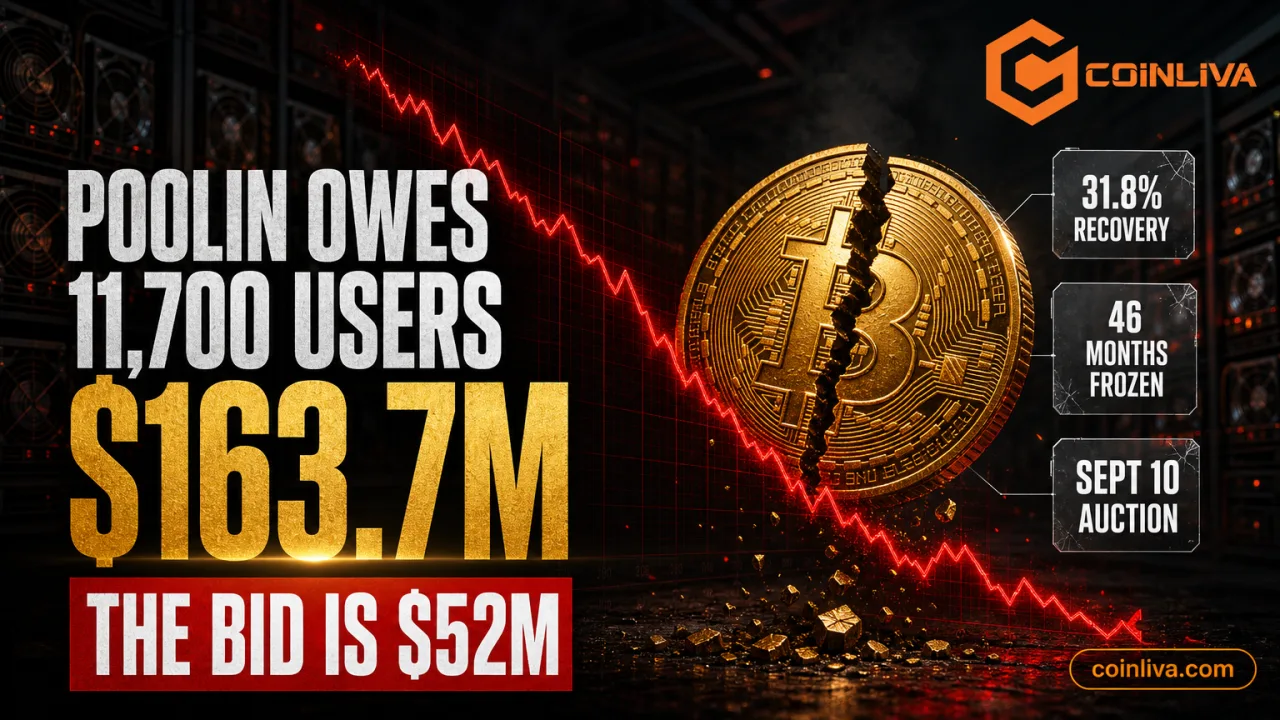
Poolin filed for Chapter 11 protection in New Jersey on July 22. Most of the coverage that followed framed it as the end of a mining company. The filing reads differently. It lists roughly $173.1 million in debt, and $163.7 million of that belongs to about 11,700 people who put crypto into a wallet product and have not seen it since September 2022. Against that sits an opening bid of $52 million for two power sites in West Texas.
Poolin has not mined at any real scale in years.
The pool stopped mining long before the filing
At its peak in 2019 Poolin ran somewhere between 18 and 20 percent of global Bitcoin hashrate, which made it the largest pool in the world at the time. CoinDesk describes its hashrate as effectively zero for a number of years now. China's 2021 ban took out the legacy operation. What survived was a Singapore holding company, two U.S. affiliates called Lonestar Dream and Lonestar Taproot, and a Texas buildout that never reached the size it was drawn for.
That buildout was planned around 600 megawatts. It got 100. Cumulative losses on the Texas sites reached $45.9 million before Poolin halted all mining and hosting on July 10 this year, keeping a skeleton crew to guard the hardware and run the sale. Equipment sales between fiscal 2023 and 2025 lost another $8.8 million. Poolin joins a short list of names that led their category and then left it quietly, the way BitMEX ran 57 percent of crypto derivatives and closed at 0.1.
Where the 2 percent to 8.8 percent came from
The wallet was the part customers cared about, and it paid. Deposit returns ran from 2 percent to 8.8 percent depending on the asset, and Poolin funded them by borrowing stablecoins against the crypto its users had handed over. That model holds up while collateral values hold up.
Bitcoin went under $20,000 in the second half of 2022. Poolin suspended wallet withdrawals in September, citing a liquidity crisis, and co-founder Kevin Pan acknowledged the problem to users over WeChat. Two months later Antalpha, the lender on the other side of those stablecoin loans, called the collateral in. Roughly $265 million went out the door. Customers holding more than $100 got IOU tokens instead of coins, a paper claim on a company whose mining revenue had already gone.
A yield product paying 8.8 percent earns it somewhere, and the somewhere is usually the part that never makes the marketing page. Uphold told CredEarn depositors their money was safe while the return came out of lending to unbanked gamers in China. Poolin's version was simpler and more fragile: one lender, one collateral asset, one price level below which the whole arrangement stopped working.
What $52 million covers, and what it does not
| Item | Figure |
|---|---|
| Owed to wallet customers | $163.7 million |
| Total listed debt | $173.1 million |
| Stalking-horse bid, two Texas sites | $52 million |
| Cash reported at the parent | about $1.2 million |
| Assets scheduled with the court | $1 million to $10 million |
| Coverage of wallet claims before costs | 31.8 percent |
Thor CALAP LLC is the stalking horse. Its $52 million splits into $15 million for the Pyote facility and $37 million for power rights and equipment at Tarbush. That split is the tell. More than two thirds of the bid is attached to an interconnect and a load capacity rather than to a building full of machines, which is the same reason the auction may attract bidders who have no interest in mining anything. Measured against the wallet claims, the $52 million comes to 31.8 percent. Before liens. Before administrative costs, which in a cross-border Chapter 11 with a Singapore parent and two Texas affiliates are not small, and before whatever the affiliates end up claiming from each other.
The parent reports about $1.2 million in a New Jersey bank account, according to CryptoSlate's read of the schedules. Those same schedules put debtor assets in a $1 million to $10 million band against liabilities of $100 million to $500 million. Wallet holders sit in the unsecured class. They queue behind anyone with a lien on Texas hardware, and behind the professionals running the case.
Frozen balances have a way of staying frozen once a court is involved. Zonda spent months explaining why 4,500 BTC sat locked in a wallet nobody could open after its founder vanished. Poolin's problem is the reverse and worse. The coins are gone, sold in 2022 by a lender exercising its rights, and what remains is a real estate question in West Texas.
September 8 is the date that matters now
Qualified offers are due September 8, with an auction pencilled in for September 10. The open question is who shows up. Power rights in West Texas are worth more to an AI data center operator than to a Bitcoin miner at current hashprice, and if one of them bids the recovery figure moves. Nobody in the case has put a number on how far.
Forty-six months have passed since Poolin stopped letting people withdraw. The 11,700 will spend at least another six weeks finding out whether a data center bidder turns up in Texas and lifts them above thirty cents on the dollar. Past September 10 the schedule in the filing stops making promises, and the numbers that decide the recovery will come from a power auction rather than from anything Poolin still does.