
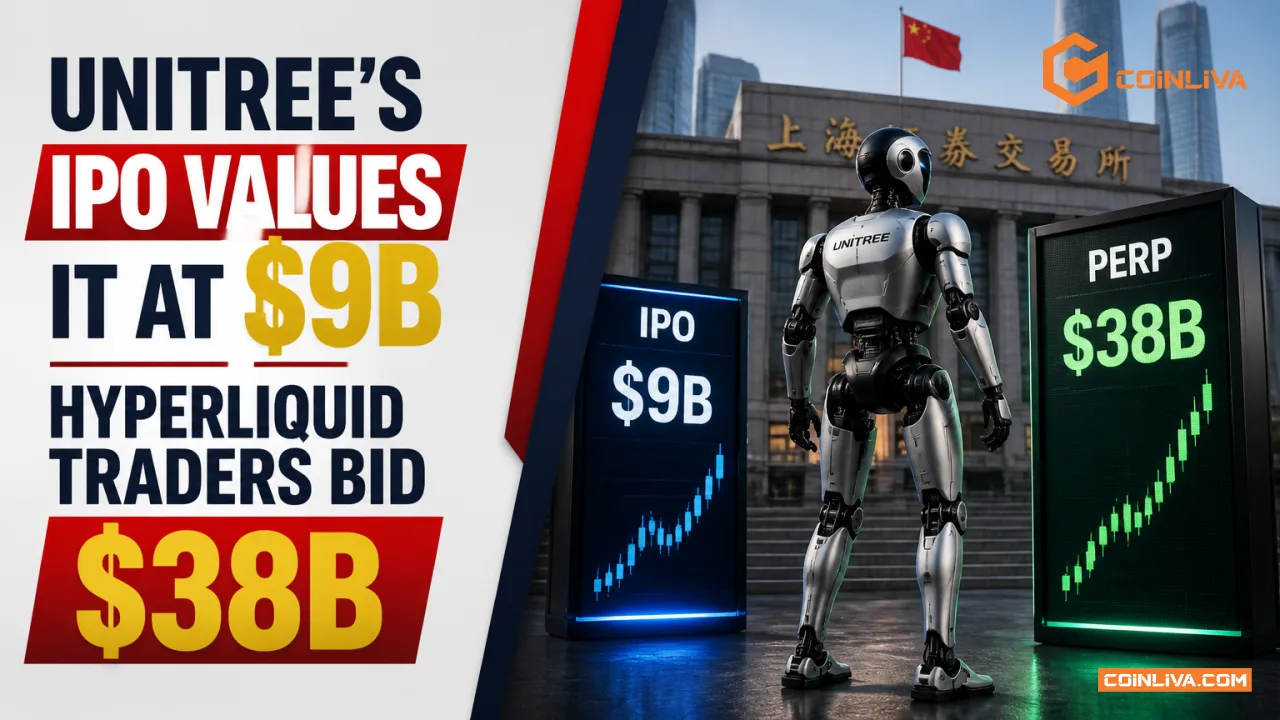
Unitree Robotics set its IPO price at 150.80 yuan, about $22.37 a share, valuing the Chinese robot maker near $9 billion ahead of its Shanghai STAR Market debut. Retail investors oversubscribed the offering roughly 8,000 times. Then look at Hyperliquid, where a pre-listing perpetual on the same Unitree stock changes hands between $92 and $94. That price implies a valuation close to $38 billion, more than four times what the underwriters wrote down.
The two figures do not describe the same thing, and the gap is the story.
| Reference | Price per share | Implied valuation |
|---|---|---|
| STAR Market IPO | 150.80 yuan ($22.37) | about $9 billion |
| Hyperliquid perp | $92 to $94 | about $38 billion |
A four times gap that has to close on debut
Open interest across the two Hyperliquid contracts sits at about $9.1 million, on roughly $59 million of volume, and the pair has tracked each other closely, trading about 1.6% apart on average. Those are small figures next to a $9 billion listing. The risk is not the size of the pool. It is the distance the synthetic Unitree price would fall if the real stock opened anywhere near its IPO mark, the kind of one-sided open interest that snaps when the crowd is caught leaning one way.
Allium, the blockchain analytics firm that flagged the setup, put the exposure plainly. Unitree "can open at twice its IPO price and still liquidate a third of long exposure." A debut at $45, double the reference, would wipe out roughly a third of long positions. A run to $128 would take out about 53% of shorts. Between those two poles sits a market that has already priced a far bigger company than the one going public this week.
The retail side is quietly fading the print
A synthetic contract like this is not bound by share supply or by an underwriter's book. It drifts to wherever traders on margin push it, which is why it can wander four times away from the IPO number. On Trade.xyz the positioning is nearly even, about $6.5 million long against $6.6 million short. Read a level deeper, though, and smaller accounts lean roughly 70% short by value. The money betting on the $38 billion print is mostly larger players, and the retail crowd is the side quietly fading it.
That split matters more than the headline valuation. When big accounts hold the longs and small ones sit short, a hot open punishes the many and a cold one punishes the few. Neither outcome is priced as a certainty here, which is what keeps the two Unitree contracts trading within touching distance of each other rather than blowing apart. The $59 million that has changed hands so far is real volume, but it rests on just $9.1 million of open interest, so a single large exit could move the mark well before the stock ever opens in Shanghai.
What a pre-listing perp actually tracks
Hyperliquid has hosted this kind of thin, opinion-driven market before. A single trade once set the price on its SK Hynix pre-IPO contract, and the exchange's own token buyback has been read against its fee flows the same way. A perp price is a wager, not a valuation. The smaller the book, the louder a handful of traders speak.
Trading is expected to open between August 17 and 21. If Unitree lists closer to its $22 reference than to the $92 the perp implies, convergence will be brutal for anyone long the synthetic. If it opens hot, the shorts pay instead. The on-chain market has already made a call the IPO price does not share, and the first days of real trading will decide which one was closer.