
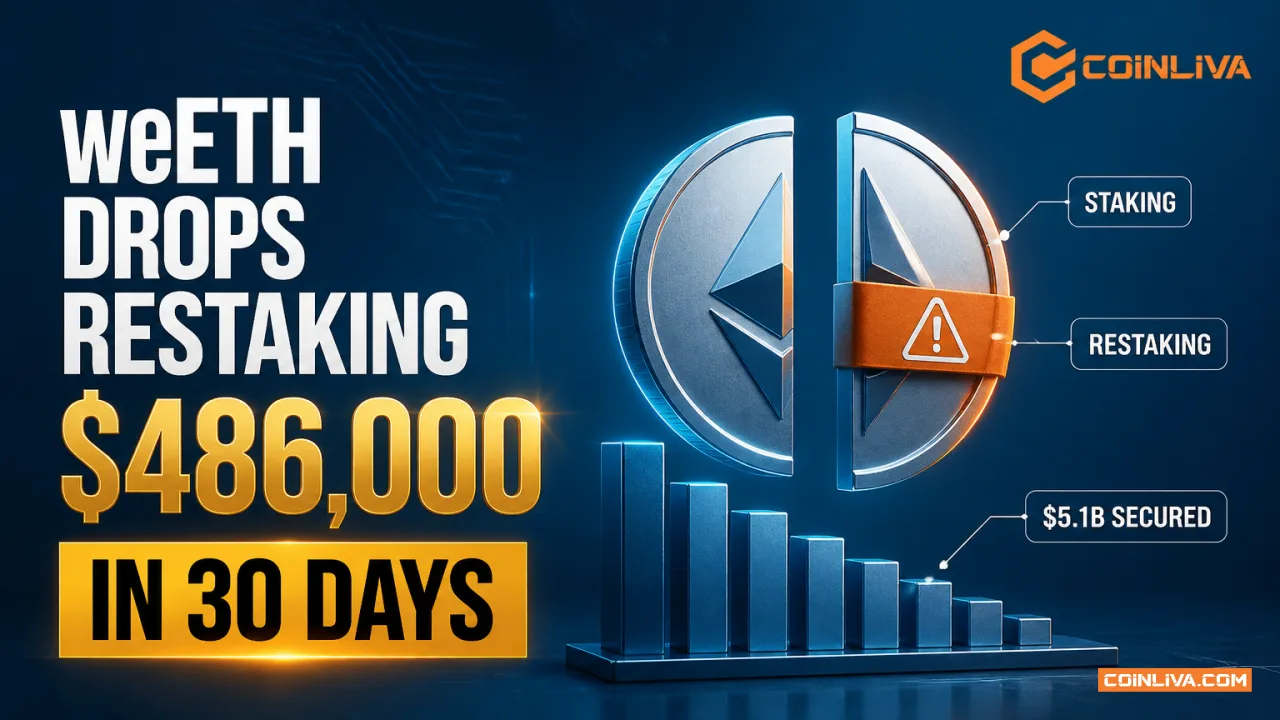
Ether.fi pulled restaking out of weETH on Thursday. The token now earns plain Ethereum staking rewards and nothing beyond that. Anyone who wants the extra layer has to hold weETHs instead, a separate token that carries restaking exposure and the slashing risk attached to it. Until this week, every weETH holder carried both whether they had asked for it or not.
Ether.fi described the weETH change as a clearer choice between basic staking exposure and additional restaking exposure. The numbers underneath the restaking side explain why the choice was worth separating out.
EigenCloud secures $5.1 billion and paid $486,066 in a month
DefiLlama figures pulled Friday night show EigenCloud, the rebranded EigenLayer, holding 5.117 billion dollars of restaked collateral. Fees generated across the trailing 30 days came to 486,066 dollars. Annualise that against the collateral securing it and the entire restaking layer is producing under 12 basis points a year.
Put it next to plain staking. Ether.fi's own fee line runs at 222.83 million dollars annualised against 3.582 billion in deposits, close to 6.2 percent, because that is what Ethereum pays validators to show up. So the restaking premium that weETH holders were quietly carrying extra risk for worked out to something near one fiftieth of the yield they already had. That gap is the argument for splitting weETH, whether or not ether.fi wanted to phrase it that way.
The composition is the part worth sitting with. DefiLlama lists EigenCloud protocol revenue at zero and incentives distributed over the same 30 days at 446,138 dollars. Most of what moved through the layer was emissions, not payments from services actually buying security. Restaking as a category holds 7.966 billion dollars across every protocol tracked, and EigenCloud is roughly 64 percent of it, so this is not a small corner of the market being measured. The gap between staking yield and what safer assets pay has been narrowing all year, which makes a near-zero second layer harder to justify to depositors.
Ether.fi keeps about a quarter of the fees it charges
The protocol generated 11.44 million dollars in fees over 30 days and kept 2.96 million of it as revenue. Annualised, that is 222.83 million against 51.23 million, a take rate near 23 percent. Cumulative fees since launch stand at 405.78 million dollars, with 97.3 million retained.
Holders see less. DefiLlama puts annualised holders revenue at 13.1 million dollars against an ETHFI market cap of 371.14 million, so the token is priced at roughly 28 times what flows back to it. That is a friendlier ratio than most staking tokens carry, and a much worse one than the outliers. HYPE routes 97 percent of protocol revenue to holders, and Lido's buyback still has not cleared its own daily trigger. Liquid staking businesses are large in deposits and thin in what reaches a token.
Deposits themselves are climbing. Ether.fi TVL is up 13.5 percent over 30 days, with 3.404 billion on Ethereum, 178.31 million on OP Mainnet, and a rounding error elsewhere.
Scroll still holds $53,939 that nobody moved
That rounding error has a history. Back in April, ether.fi told users it was shutting weETH bridging on eight smaller chains, Scroll and Swell and Bera and zkSync and Mode and Blast and Morph and Sonic, with a June 30 deadline and a 0.5 weETH fee for manual recovery after it. The trigger, as AMBCrypto reported at the time, was the rsETH exploit at Kelp DAO and how quickly a problem in one wrapper spreads through everything holding it.
Five weeks past that deadline, DefiLlama still lists 53,939 dollars of ether.fi deposits sitting on Scroll. Small money, and a fair chunk of it is probably stuck in positions whose owners stopped reading announcements. The recovery fee is larger than plenty of the individual weETH balances down there.
The same April coverage put ether.fi's Ethereum deposits at 5.1 billion dollars. The tracker now shows 3.404 billion. How much of that is withdrawals and how much is the ether price is not something a TVL line separates, and trackers disagree with each other badly enough that the number deserves a wide error bar either way.
All of this lands while Ethereum researchers are pushing a proposal to burn validator rewards down to nothing once half the supply is staked, roughly 60 million ether against the third or so staked today. Ether.fi founder Mike Silagadze has come out against it, arguing it hurts smaller stakers. He runs a business whose entire fee line is the staking reward, so the position is not surprising. What the split does, in the meantime, is let ether.fi find out how many weETH depositors actually want restaking when they have to ask for it. That number should be readable in the weETHs balance within a few weeks.