
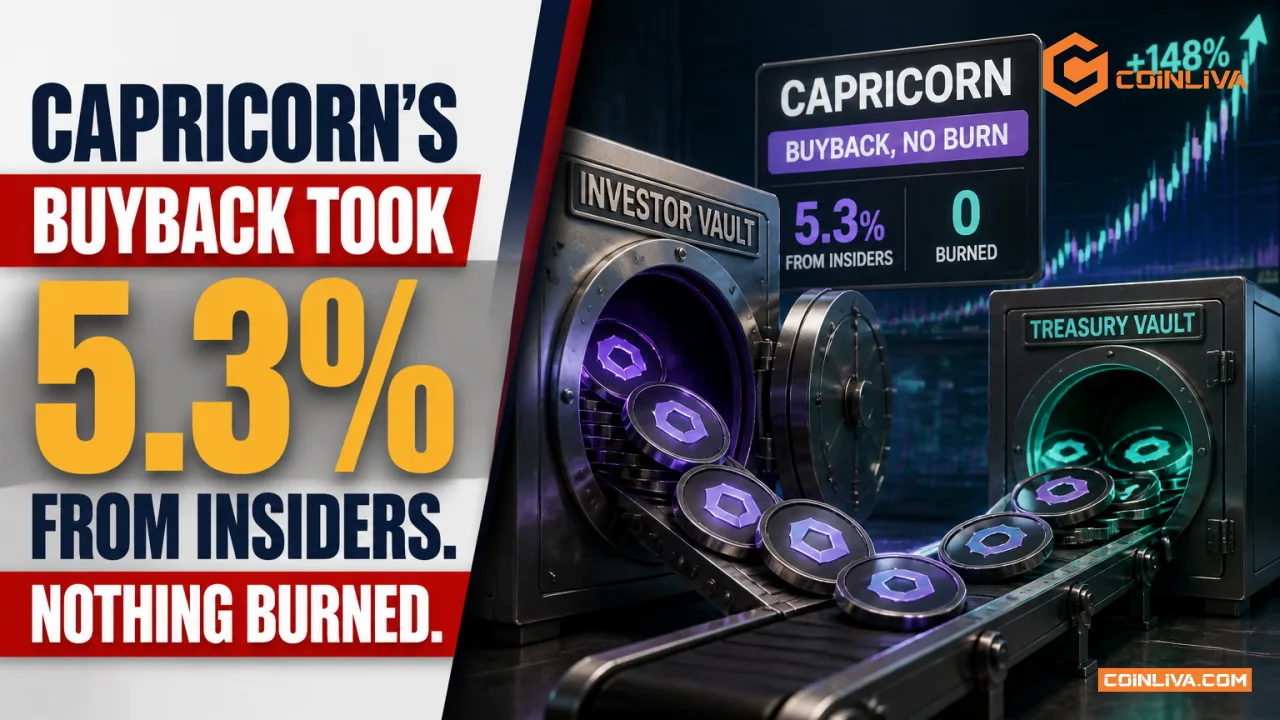
Capricorn's token doubled in a day, and the trigger was a buyback. Markets usually read a buyback one way: fewer tokens in circulation, a higher floor under the price. That reflex has misfired lately, most visibly when Aave's buyback bought the local top. It does not fit what Capricorn actually did either.
On August 13 the DeFi protocol formerly known as aPriori rebranded to Capricorn and kept its APR ticker. With the new name came a buyback of 5.3% of total supply, roughly 53 million tokens worth about $26 million, all of it bought from early investors. APR flew. CoinDCX logged a 96% gain over 24 hours, CoinMarketCap put the jump at 115% to $0.4469, and CryptoSlate showed the token up around 148% on the week. Near $8.79 million in short positions got liquidated on the way up.
The rebrand was not the only spark. APR also picked up a new exchange listing on Exolix that trackers tied to a 38.2% move of its own.
Now look at where those tokens went. They were repurchased and then redirected into community incentives and growth programs. They were not burned. A burn removes supply for good, and even the honest kind can underwhelm; Lido's program needs more daily revenue than it earns to fire at all. Capricorn's did not even try to shrink supply.
It shifted 5.3% of APR out of early backers' wallets and into a treasury bucket that feeds it back to the market over time. The circulating float did not move. Ownership changed hands, and the sellers were insiders pulling about $26 million out near a local high, a move that echoes Story's twice-delayed insider unlock from earlier this month.
Most of the supply hasn't arrived yet
Capricorn shows a market cap around $146 million against a fully diluted value near $525 million. That gap is the real story. Only 27.8% of the one billion APR supply is circulating, so close to three quarters of the tokens are still scheduled to unlock. A 5.3% repurchase that stays inside total supply does nothing about that overhang. It changes who owns the coins, not how many will exist. Buying tokens back from early investors and parking them in a treasury is closer to a transfer than a reduction.
| Metric | Figure |
|---|---|
| Buyback size | 5.3% of total supply (about 53M APR) |
| Estimated value | about $26 million |
| Tokens burned | 0 |
| Sold by | early investors |
| Market cap | about $146 million |
| Fully diluted value | about $525 million |
| Circulating supply | 27.8% of max |
| 7-day price gain | about 148% |
Half the supply sits in one wallet
Concentration is the part the rally skipped past. One tracker flags a single wallet holding close to 49% of Capricorn's supply. The pattern is not new here. When aPriori ran its genesis airdrop, on-chain analysts reported that one entity had spread thousands of wallets to claim a majority of the giveaway. When half a token sits in one address, the exit is always a single transaction away. A buyback that hands early investors a cash door while that address stays put does little to calm the risk.
What the token is priced against
None of this erases what Capricorn runs. The protocol offers liquid staking on Monad, where staked MON returns aprMON, and it operates order-flow infrastructure that routes value back to stakers and validators. That is a working product with a real user base, and on a young chain like Monad an early liquid-staking position carries genuine strategic worth. The harder figure to square is the valuation. A fully diluted value near $525 million asks this network to earn like a mature protocol while most of its supply has not yet reached the market. A buyback that removes nothing does not close that distance. The unlocks scheduled across the rest of 2026 will test it directly, long after the rebrand spike has faded.