
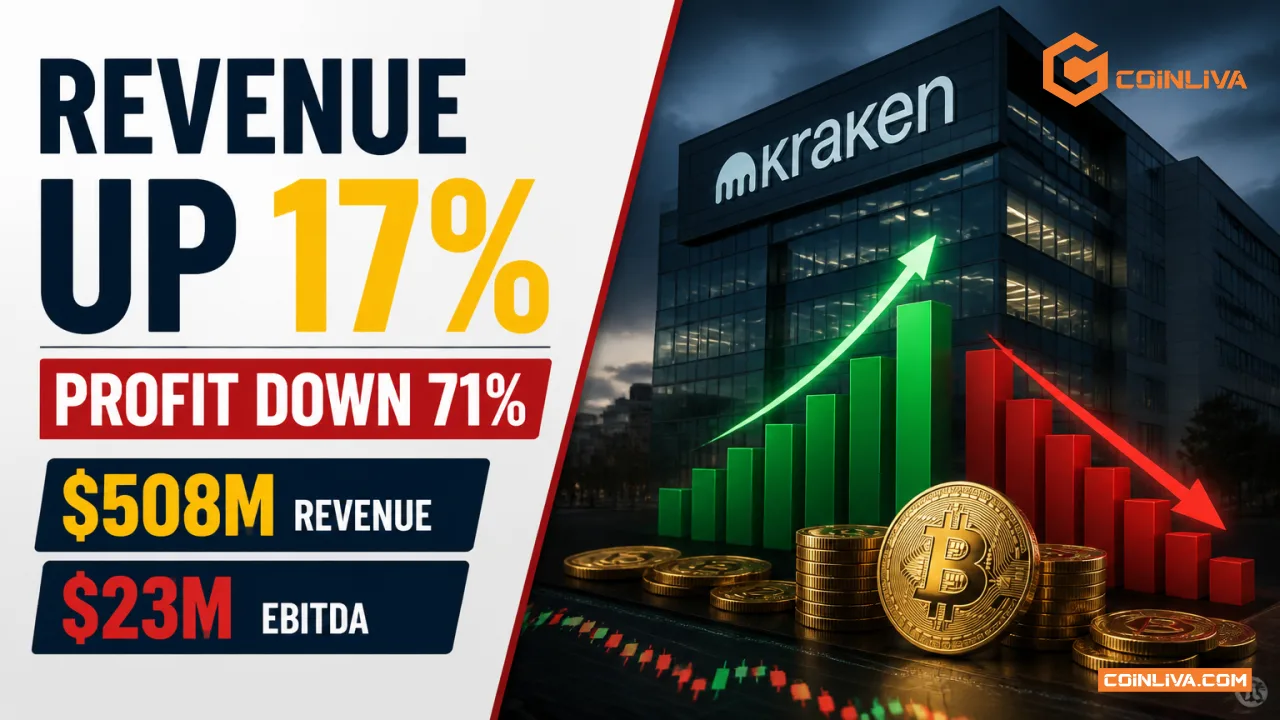
Payward, the company behind the Kraken exchange, told investors its revenue rose 17 percent last quarter. Most coverage stopped at that line. The number sitting under it is harder: adjusted EBITDA came in at $23 million, down 71 percent from a year earlier. Revenue grew. The business that revenue is supposed to reflect did not.
Here is what Payward actually reported for the second quarter of 2026.
| Metric | Q2 2026 | Change vs Q2 2025 |
|---|---|---|
| Adjusted revenue | $508 million | +17% |
| Total transaction volume | $310 billion | -18% |
| Adjusted EBITDA | $23 million | -71% |
| Funded accounts | 6.6 million | +42% |
| Asset-based and other revenue | 60% of total | from 55% |
The revenue grew, but not from trading
Trading is what an exchange is built to do, and trading shrank. Total platform volume fell to $310 billion. Payward's own release puts that decline at 18 percent year over year, though several outlets repeated a softer 13 percent figure that traces back to an earlier read of the same quarter. Either way, the direction is down, and it is down across the industry. Volume has been draining out of the market for months.
So where did the 17 percent come from? Balances, not activity. Asset-based and other revenue, the money Payward earns on client holdings rather than on trades, climbed to 60 percent of total revenue from 55 percent a year earlier. Trading fees, once nearly half the pie, now sit at 40 percent. Real assets on the platform grew 48 percent to $65 billion, and interest on that pile keeps flowing whether customers trade or not. It is the same rotation Coinbase leaned on when its own trading desk cooled: lean on the assets sitting still.
A profit line that keeps thinning
The 71 percent EBITDA drop is not a one-quarter stumble. Payward posted an 89 percent EBITDA slide in the first quarter on almost identical revenue. Two quarters running, the top line holds near $508 million while the profit underneath falls by most of its value. A year ago the same quarter cleared close to $80 million in adjusted EBITDA, per figures pulled from the results materials. This one cleared just $23 million.
The company has not been idle about costs. Payward cut roughly 150 jobs earlier this year and, in its own words, aligned spending with market conditions. That did not close the gap, because the gap is on the revenue-mix side, not the payroll side. When your highest-margin line is trading fees and traders go quiet with Bitcoin sitting around half its October 2025 peak, cutting staff only slows the bleed. Fixed costs stay fixed while the fees that used to cover them shrink.
What the 6.6 million accounts are really worth
There is a genuine bright spot, and it sits at the top of the funnel. Funded accounts rose 42 percent to 6.6 million, the kind of growth that pays off later if those users stay and eventually trade. That is the bet embedded in the whole quarter: acquire now, monetize when volume returns. It is a reasonable bet, but it is a bet, and it does not show up in this quarter's profit line at all.
Timing sharpens the stakes. Kraken has hired banks and is spending toward a public listing, and a diversified, balance-heavy revenue base reads better to bankers than a pure trading shop exposed to every dip in sentiment. The risk is the mirror image. A book that leans on interest income and client balances looks a lot like a bank, and banks trade at lower multiples than the growth story an exchange wants to tell. For now the pitch is a company getting bigger and less profitable in the same breath, and the next quarter will show whether those 6.6 million accounts turn back into the fees that once carried the whole model.